The Harvard Foundry Bootcamp starts now. In this article, I'm sharing why I applied, and what it has to do with the conversations I've been having with NP entrepreneurs (in and outside of dermatology) about money for the past five years. You'll see how the same competitive advantage that keeps six and seven figure earners from deploying their own capital is also what keeps NPs from claiming government contracts that are already looking for exactly what we do. You'll get the real numbers behind that opportunity, and a look at what founder education actually asks of you before you ever pitch anyone. And you'll walk away knowing exactly how to explore the Foundry Bootcamp for yourself, whether or not Harvard turns out to be your room.
Why I Applied to the Harvard Foundry Bootcamp
Nurse practitioner entrepreneurs carry a nursing superpower most of us have not yet learned to point outside the clinic: the instinct for building trust fast and making high-stakes decisions under pressure. What most of us have not yet built is the same instinct for customer acquisition and capital.
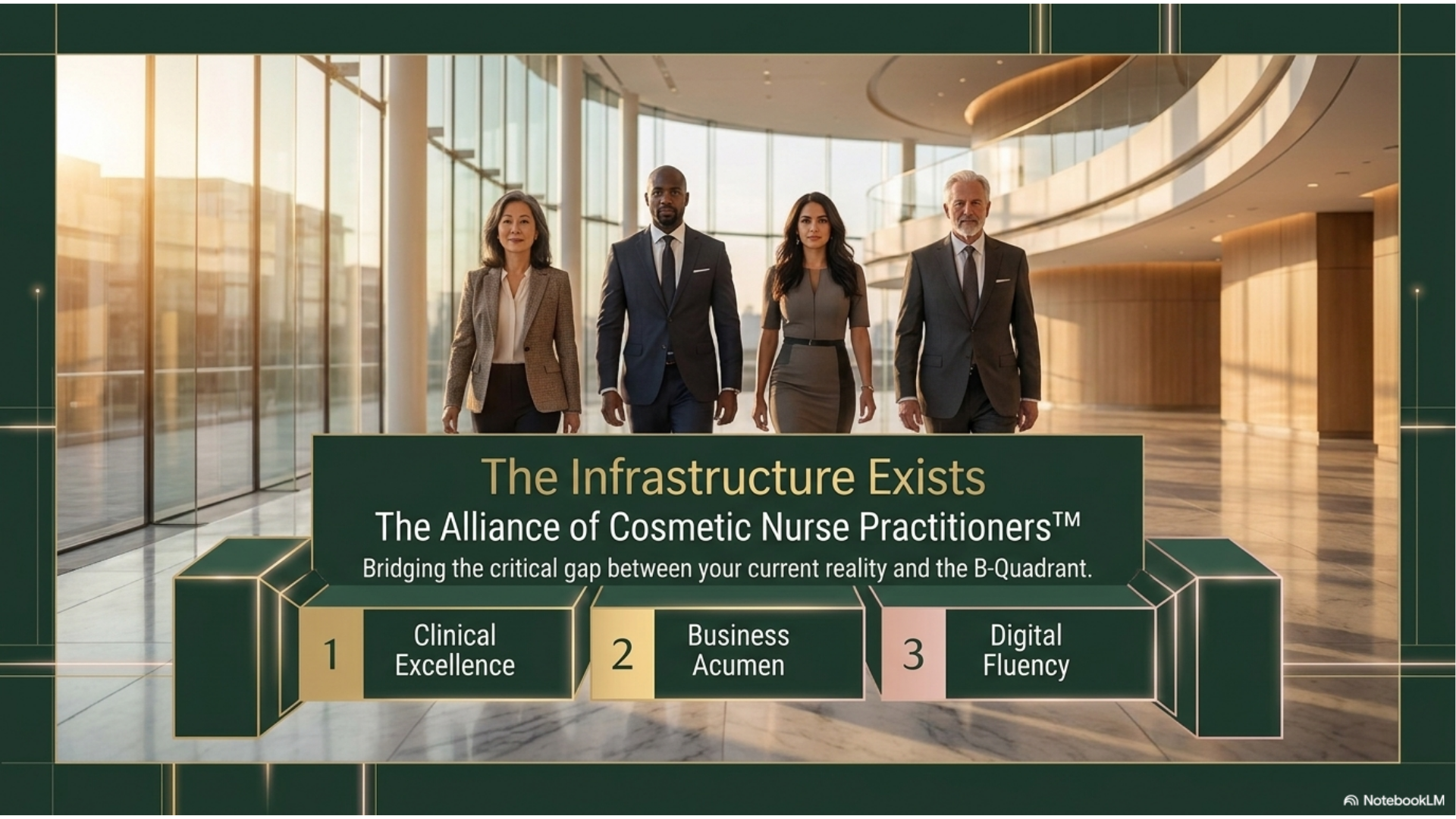
We know how to treat patients. We know how to build protocols, run clinics, and deliver care that changes lives. The Alliance exists to teach the other side of that: how to find the next customer, and how to direct capital with intention once you have it.
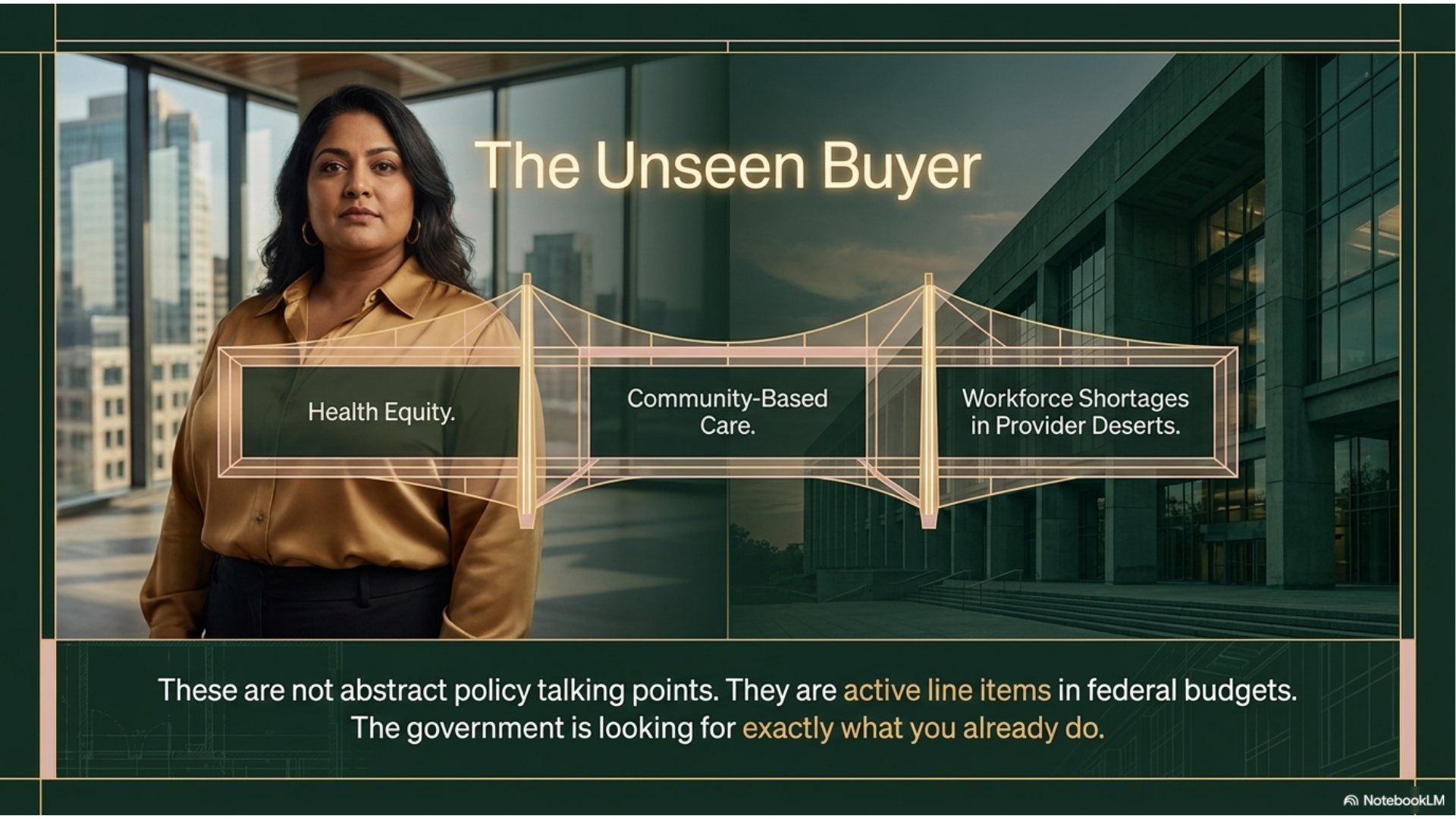
At the same time, the government is actively looking for people to solve problems nurse practitioners are already equipped to solve. Health equity. Community-based care. Workforce shortages in provider deserts. These are not abstract policy talking points. They are line items in federal budgets, and they are contracts that go to whoever shows up prepared to bid on them.
Most NPs already know, in a general sense, that government contracts exist. What stops most people from pursuing them is time, and the sense that the system sounds complicated to enter. Turning that sense of complexity into a competitive advantage is exactly the kind of teaching we exist to do.
That is why I applied to Harvard Business School's Foundry Bootcamp.
What I Already Know About Building the Stadium
I have spent years watching NP entrepreneurs work in silos which remind me of a good scrimmage game. Some scrimmage games go well. Others do not. What I kept coming back to was a simple question: what if everyone was in one stadium, like the Olympics? What if I was the lady who built the stadium?
That question is what became the Alliance of Cosmetic Nurse Practitioners™. Nursing school ignores skin of color. Dermatology training doesn't include entrepreneurship. Cosmetic training doesn't care about your nursing experience. We address all three, because too many NPs get sold an escape from burnout, only to create a new job for themselves and go bankrupt within two to three years.
Building that stadium taught me something that applies directly to customer acquisition and capital: NPs do not need more content. They need infrastructure, already built, and a teacher who has walked the confusing path first.
Put Yourself in Rooms Where You're Not the Smartest
I can build community. That is proven. The next competitive advantage I am building is the kind of founder judgment that comes from sitting inside a room designed specifically to take an idea from instinct to a funding-ready pitch, tested against people who have done this at scale.
That is what Foundry is. It is Harvard Business School's founder education platform, and the Founder Mindset Bootcamp is an eight week, virtual program open to any industry, with no pitch deck or prior startup experience required. It pairs an AI mentorship layer modeled on HBS faculty frameworks with live sessions from real experts, and it works through problem definition, market mapping, and a traction strategy. Foundry takes no equity and claims no rights to what founders build inside it. Top participants are invited into Foundry Catalyst, where they compete for funding at Harvard Business School itself.
I am not sharing the specifics of what I am building inside the program. Some of it is still taking shape, and some of it is intentionally private while it does. What I want every NP reading this to take from it is simpler: the decision to apply mattered more than the outcome of the application, and that decision is available to you too, regardless of what stage your business is in.
What I've Already Been Teaching About Money in This Profession
For the past five years I have had the same conversation, in different cities, with NP entrepreneurs generating $300,000, $500,000, even $1M or more a year. Some run wellness centers offering hormone therapy and aesthetic services. Some operate mobile practices or telehealth platforms. A few own brick-and-mortar clinics with teams of five to ten people.
When I ask what they are doing with that capital strategically, the answer is almost always some version of the same thing: I don't know what I would do with $50,000. Not "I don't have it." They have it. They don't know what to do with it.
An article titled, Why Nurse Practitioners Making $300K-$1M+ Don't Know How to Deploy Capital, became the number one piece on the Mahogany Dermatology blog, and for the first time in three years, the most read article wasn't about dermatology. It was about money, without a single new post published in the months leading up to it. It resonated because it named something specific: a lot of cosmetic NPs are earning at a level that qualifies as running a business while still operating financially like they are self-employed. In the Cashflow Quadrant, that is the difference between the S quadrant and the B quadrant. If you stop seeing patients and the revenue stops, that is self-employment with a fancy title, whatever the number on the P&L (Profit and Loss statement) says.
That distinction between earning and building is the same one underneath the government contracting opportunity. A cosmetic NP entrepreneur sitting on undeployed capital and an NP who has not yet looked at a federal grant are experiencing the same competitive advantage from two different directions. One already has the capital and needs a framework for deploying it. The other already has the clinical and community expertise a federal agency would pay for, and needs to see where that value is being requested. Teaching NPs to see both sides of that equation, capital and opportunity, is the work I have already been doing in this niche. Foundry is where I am building the founder-level fluency to take that teaching further.
The Opportunity Is Bigger Than Any One of Us
The government spent over $100 billion on information technology in a single year, and the demand for people who can solve health-adjacent problems inside that system is growing faster than the supply of people positioned to meet it. That demand is a direct market opportunity for NP-led businesses, and it is exactly the kind of opportunity we teach our members to see and claim.
Founder education is one of the tools that turns "an opportunity exists" into "I know how to walk into the room and claim it." Programs like Foundry are explicit that they want founders from every industry, including healthcare, and they do not require you to arrive with a finished company. They ask for a real problem, a real population, and a willingness to build what Foundry's lead professor, Reza Satchu, calls founder judgment: the ability to act and commit before the outcome is certain.
That is a nursing superpower already. We make high-stakes decisions under uncertainty at the point of care every day, and that same judgment translates directly into building something that outlives our own hours in the clinic.
Harvard Does Not Have a Nursing School
Harvard does not have a standalone school of nursing today, and that absence has real history behind it. In the late nineteenth and early twentieth century, there was a serious push for a Harvard School of Nursing, one that would have placed nursing inside Harvard's university structure from the beginning instead of routing it through hospital-based training. Nursing historian Frances Ward documented that proposal in a 2010 analysis published in Nursing Inquiry, calling it "a road not taken."
According to Ward's research, the proposal did not move forward for reasons that will sound familiar to anyone who has spent time inside nursing education. The nursing superintendents of that era welded nursing training to hospitals, building a curriculum tied to hospital service instead of independent academic standing. That choice reinforced a model where nursing operated under physician authority rather than as its own discipline inside elite higher education. A more contextual, community-oriented vision of nursing, championed at the time by Alfred Worcester and Annette Fiske, met real backlash and lost ground to the hospital-based model that became the norm.
Harvard still does not offer an undergraduate nursing degree or a standalone nursing school. What it offers now are nursing-adjacent pathways through public health leadership programs and pre-nursing advising for students who complete their nursing degree elsewhere.
A school built to elevate medicine, the same institution nursing was quietly routed around more than a century ago, is now reviewing a nurse-led vision on its own merit. I am thrilled about that. Not because it helps me, but because it helps all of us. We always talk about representation, more specifically someone representing us. This acceptance allows me to be the person representing you. I do not take that for granted. It is a seat at the table nursing was denied the first time the invitation was on the table. This time, our nursing superpower got us in the room.
What This Acceptance Means for You
If you have felt like you were practicing in a silo, wondering whether the resources and funding you keep hearing about were built for someone else, here is what we want you to know: we built the Alliance of Cosmetic Nurse Practitioners™ because we are already doing the teaching. Adding founder education to what you are building is the next step. You do not need a finished business plan to explore it. You need the willingness to apply and the discipline to follow through once you are in.
Take the Next Step
Explore the Founder Mindset Bootcamp for yourself at hbsfoundry.org. Whether or not Harvard is the right room for where you are right now, the exercise of asking whether you are ready to think like a founder is worth doing regardless. And if you want the version of this conversation built specifically for nurse practitioners, business acumen and digital fluency alongside clinical excellence is the whole reason The Alliance of Cosmetic Nurse Practitioners™ exists. Join us there, and follow along on The Melanin Initiative Podcast as this next chapter unfolds.
About the Author
Dr. Kimberly Madison, DNP, AGPCNP-BC, WCC is a Board-Certified, Doctorally-prepared Nurse Practitioner, educator, researcher, and author dedicated to advancing dermatology nursing education with an emphasis on skin of color, business acumen, and digital literacy. She is the founder of Mahogany Dermatology Nursing | Education | Research™ and the Alliance of Cosmetic Nurse Practitioners™, the first dermatology nursing organization in the country built at the intersection of clinical excellence, skin of color care, and financial literacy for nurses. A selected participant in the Harvard Business School Foundry Mindset Bootcamp (2026), Dr. Madison continues to sharpen the entrepreneurial infrastructure behind her mission. Through peer-reviewed research, published books, and a growing community of nurse entrepreneurs, Dr. Madison is building the infrastructure that makes this profession sustainable for the people who choose it.
.svg)

.svg)
.svg)