Nyla sits in on her first real patient visit, a case of post-inflammatory dyspigmentation that most training programs still leave out of the conversation on deeper skin tones. What she witnesses in that exam room becomes the doorway into her next business lesson: Present Value, the deceptively simple idea that a dollar today is never worth the same as a dollar next year. You'll walk away with a plain-language grasp of one of finance's foundational concepts and a clearer picture of why skin of color competency and business literacy have to be taught together, not as separate tracks.
Chapter Two: The Patient and the Price Tag
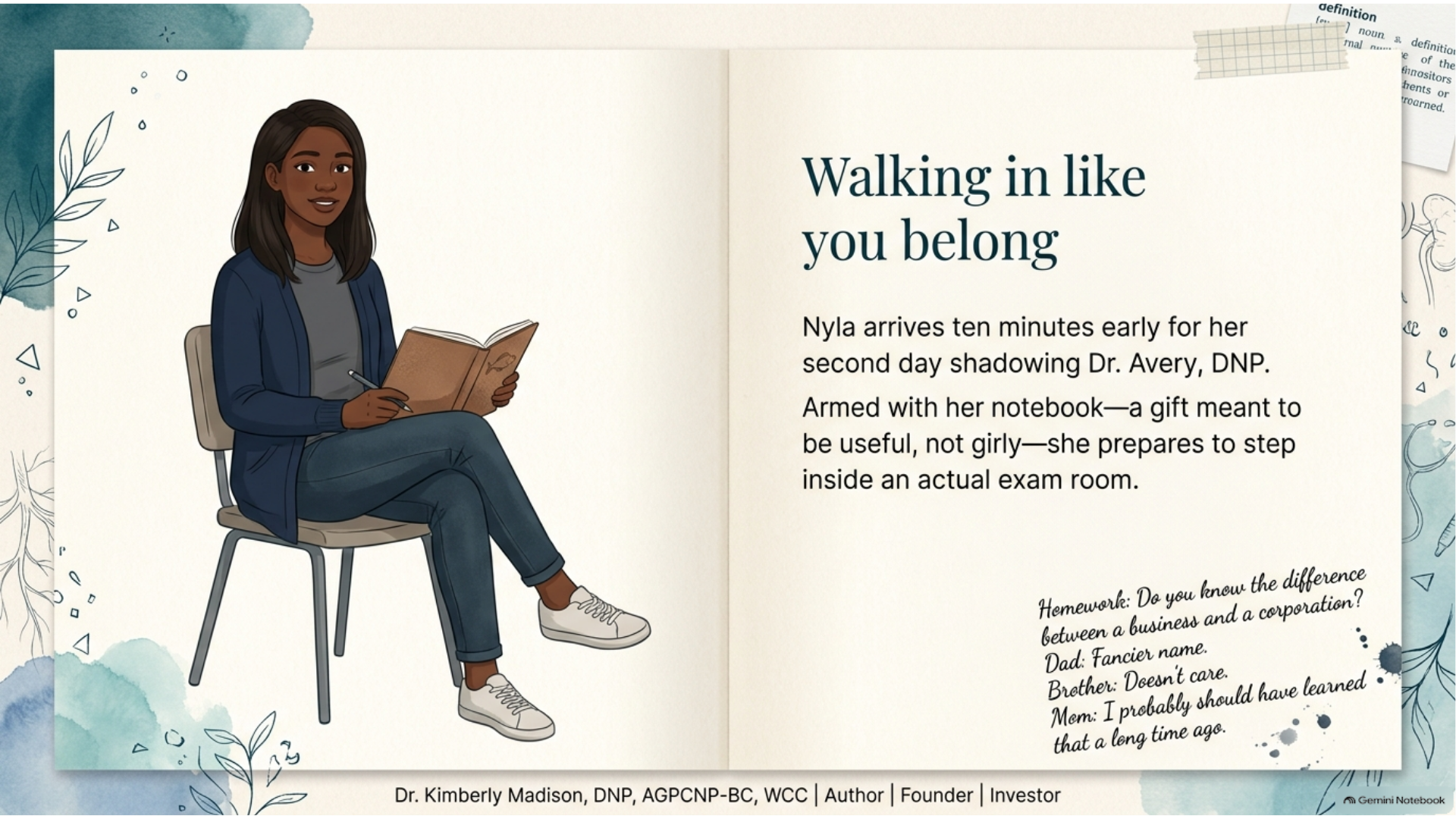
Nyla showed up ten minutes early this time. She had made herself a promise on the drive over, after her brother teased her for being nervous the first day, that she would walk in like she belonged there. She sat in the same waiting room chair, but her arms were not crossed this time. She had a notebook open on her lap, the one her mom bought her for her birthday with a little embroidered fish on the cover, because Nyla had asked for something "useful, not girly," and her mom had found a loophole.
Dr. Avery, DNP came out a few minutes later, holding a folder. "Ready for round two?"
"I already did my homework," Nyla said. "I asked my whole family if they knew the difference between a business and a corporation."
"And?"
"My dad said a corporation is just a business with a fancier name. My brother said he didn't know and didn't care. My mom got quiet and said she probably should have learned that a long time ago."
Dr. Avery, DNP smiled at that last part in a way that told Nyla it mattered more than the others. "That's usually how it goes. Come on back. Today's a little different. You're going to sit in on a patient visit with me first."
Nyla blinked. "Like, actually in the room?"
"With permission, yes. I already asked the patient if a student could observe. She said yes."
They walked back together, and Dr. Avery, DNP knocked once before opening the door. A young woman, maybe in her early twenties, was sitting on the exam table. Her arms were crossed the way Nyla's had been on day one.
"This is Nyla," Dr. Avery, DNP said. "She's shadowing with me this summer. Is it still alright if she stays?"
The patient nodded, though she still looked a little unsure. Dr. Avery, DNP sat down across from her and did not reach for a chart or a light first. She asked her how she was doing, actually waited for the answer, and then asked what had been bothering her.
Nyla noticed, there were dark, flat patches scattered along her forehead, some old and some newer, in places where Nyla could tell there used to be breakouts.
"I had really bad acne for like two years," the patient said. "It finally cleared up. But now I have this instead, and honestly it's almost worse. People keep telling me it'll fade on its own, but it's been over a year."
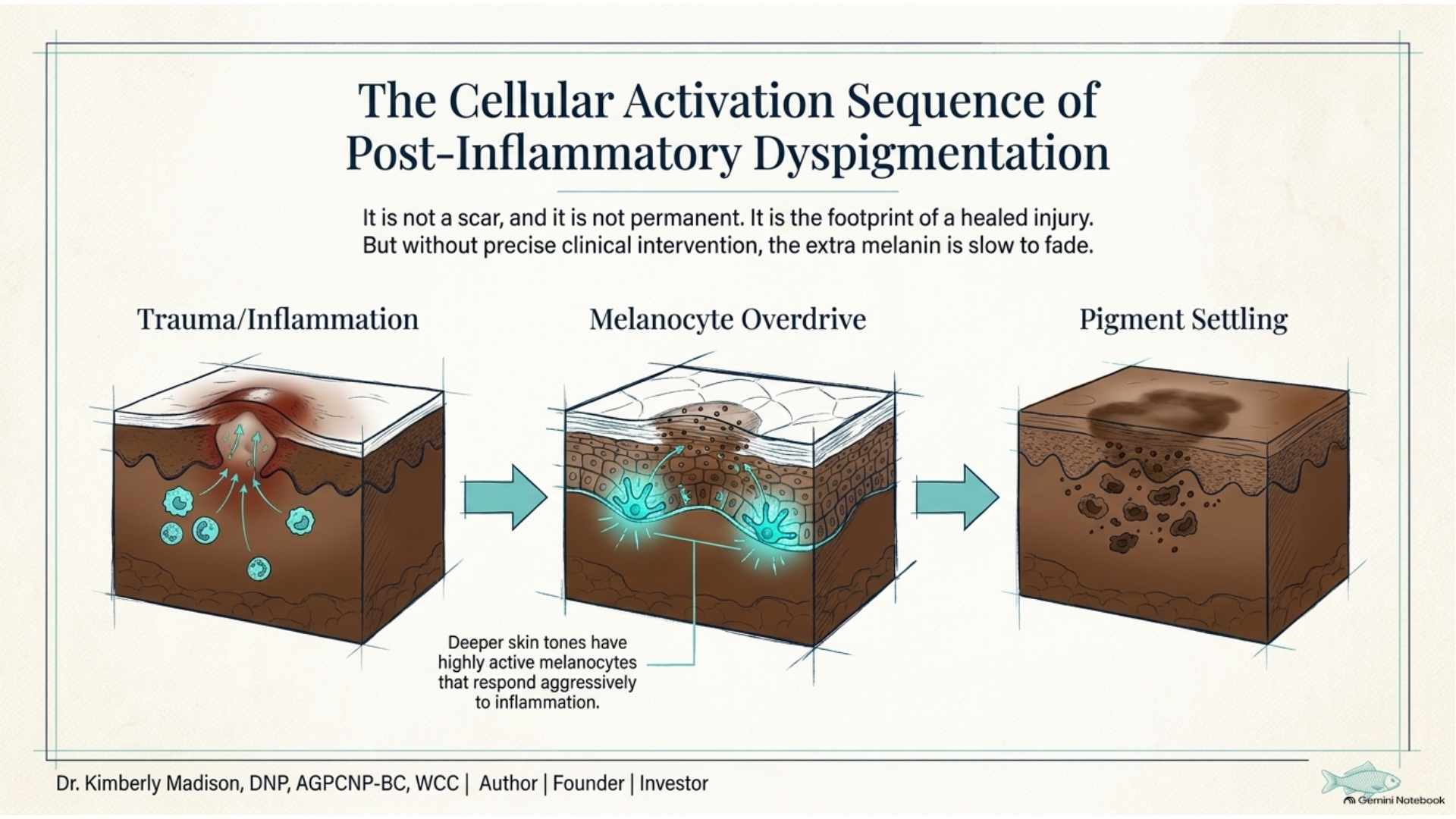
Dr. Avery, DNP examined her carefully, then explained what she was seeing. "This is called post-inflammatory dyspigmentation. It's what happens after your skin heals from something like acne, and in deeper skin tones, that healing process can leave marks like this behind, sometimes for a long time. It's not a scar exactly, and it's not permanent, but it responds differently to treatment than it would on lighter skin, and a lot of providers either don't know that or don't take the time to explain it."
"So it's not just me being impatient," the patient said quietly.
"No," Dr. Avery, DNP said. "It's not."
Nyla stayed still in her chair, but something in her chest had gone tight. She thought about the nurse practitioner who had knelt down to her eye level when she was twelve, the one who took the time. She was watching that same thing happen again, from the other side of the room.
After they walked the patient through a treatment plan and stepped back out into the hallway, Dr. Avery, DNP turned to Nyla. "You got quiet in there."
"That's basically what happened to me," Nyla said. "Not the exact same thing, but someone finally explaining it instead of just telling me to wait it out."
"That's the job," Dr. Avery, DNP said. "Half of dermatology, especially for patients who look like her and like you, is just being the first person who actually knows what they're looking at."
"But why does it happen in the first place?" Nyla asked. "Like, actually happen. Not just 'skin heals weird.'"
Dr. Avery, DNP leaned against the doorframe. "You have cells in your skin called melanocytes. Their whole job is to make melanin, which is what gives skin its color. When your skin gets hurt or inflamed, even from something as ordinary as a breakout, those melanocytes can go into overdrive and produce extra melanin as part of the healing process. That extra pigment settles right into the skin where the damage was. Deeper skin tones have more active melanocytes to begin with, so that same healing response tends to leave a mark that's darker and slower to fade than it would on lighter skin."
"So it's not that her skin is doing something wrong," Nyla said. "It's doing exactly what it's supposed to do. It just shows up more."
"Exactly." Dr. Avery, DNP said. "Most dermatology training doesn't teach that well. Textbooks have historically shown these conditions on lighter skin, if they show them at all. So a lot of providers finish school never having seen what you just saw, on the skin tone where it actually shows up most. That's not a small gap. That's patients getting told to wait it out for a year by someone who was never taught what they were looking at."
Nyla frowned. "That seems like something that should have been fixed a long time ago."
"It should have been," Dr. Avery, DNP said. "It's part of why places like this one exist. You don't just learn skin conditions here. You learn them on the patients who actually walk through that door."
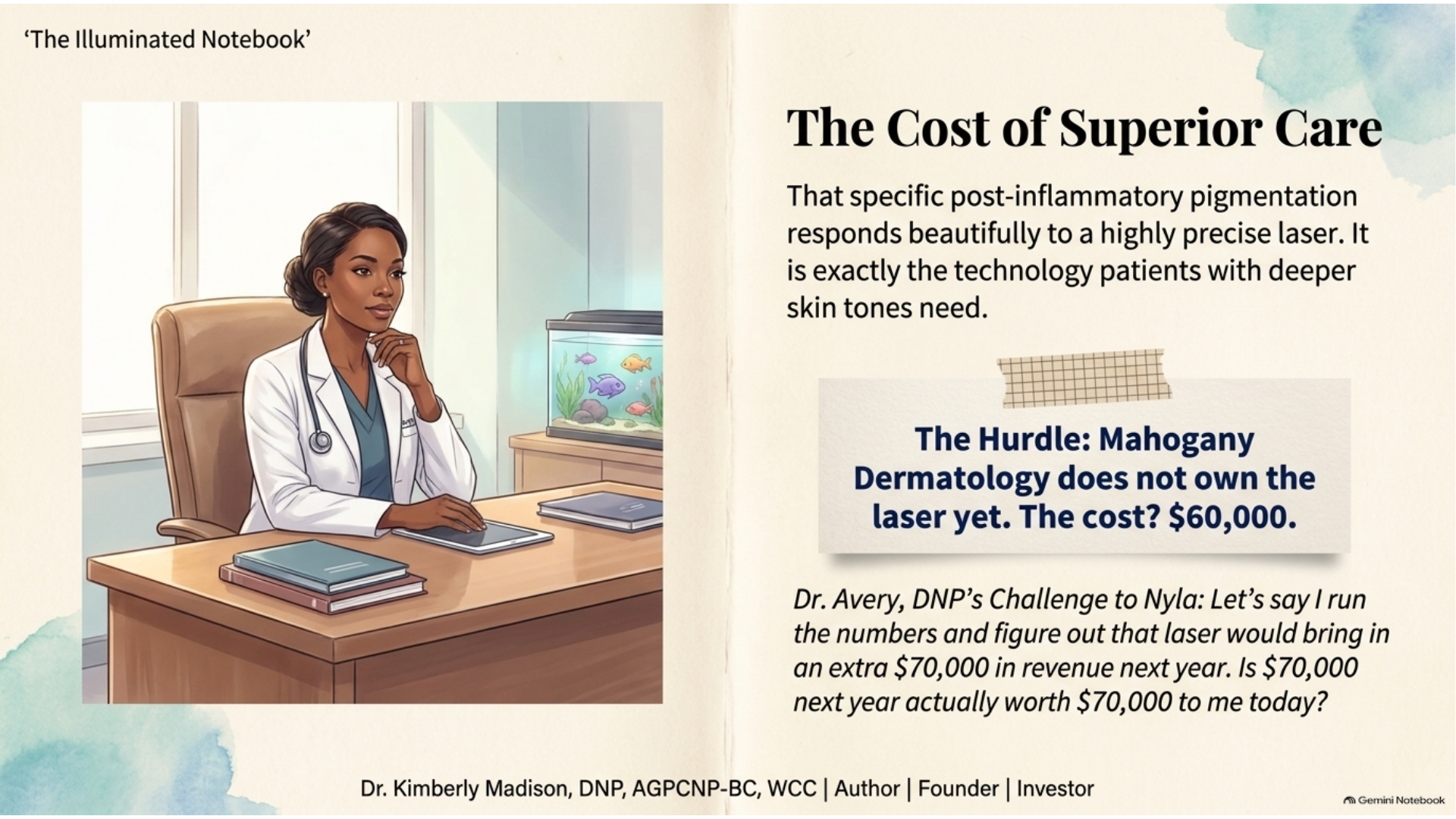
They walked back to the office with the fish tank, and Dr. Avery, DNP sat down behind her desk. "Now here's where today gets interesting. That kind of pigmentation responds well to a specific laser treatment. It's more precise than the older equipment we have here. Mahogany doesn't own one yet."
"Why not, if it works better?"
"Because it costs $60,000," Dr. Avery, DNP said. "And that's exactly the kind of decision I want to teach you how to think through."
Nyla sat up a little straighter.
"Let's say I run the numbers and figure out that laser would bring in an extra $70,000 in revenue next year, once you count the new patients it would attract and the better outcomes for people like the patient you just met. Here's the question: Is $70,000 next year actually worth $70,000 to me today?"
Nyla thought about it. "I mean... it's the same number."
"It feels that way," Dr. Avery, DNP said. "But it's not. A dollar today is worth more than a dollar a year from now, because if I have it today, I can put it to work today. I could invest it, I could use it to grow the practice faster, I could do a hundred things with it right now that I can't do with a promise of money later. So before I compare that future $70,000 to the $60,000 the laser costs today, I have to figure out what that future money is actually worth to me right now. That's called Present Value."
"Okay," Nyla said slowly. "So how do you figure that out?"
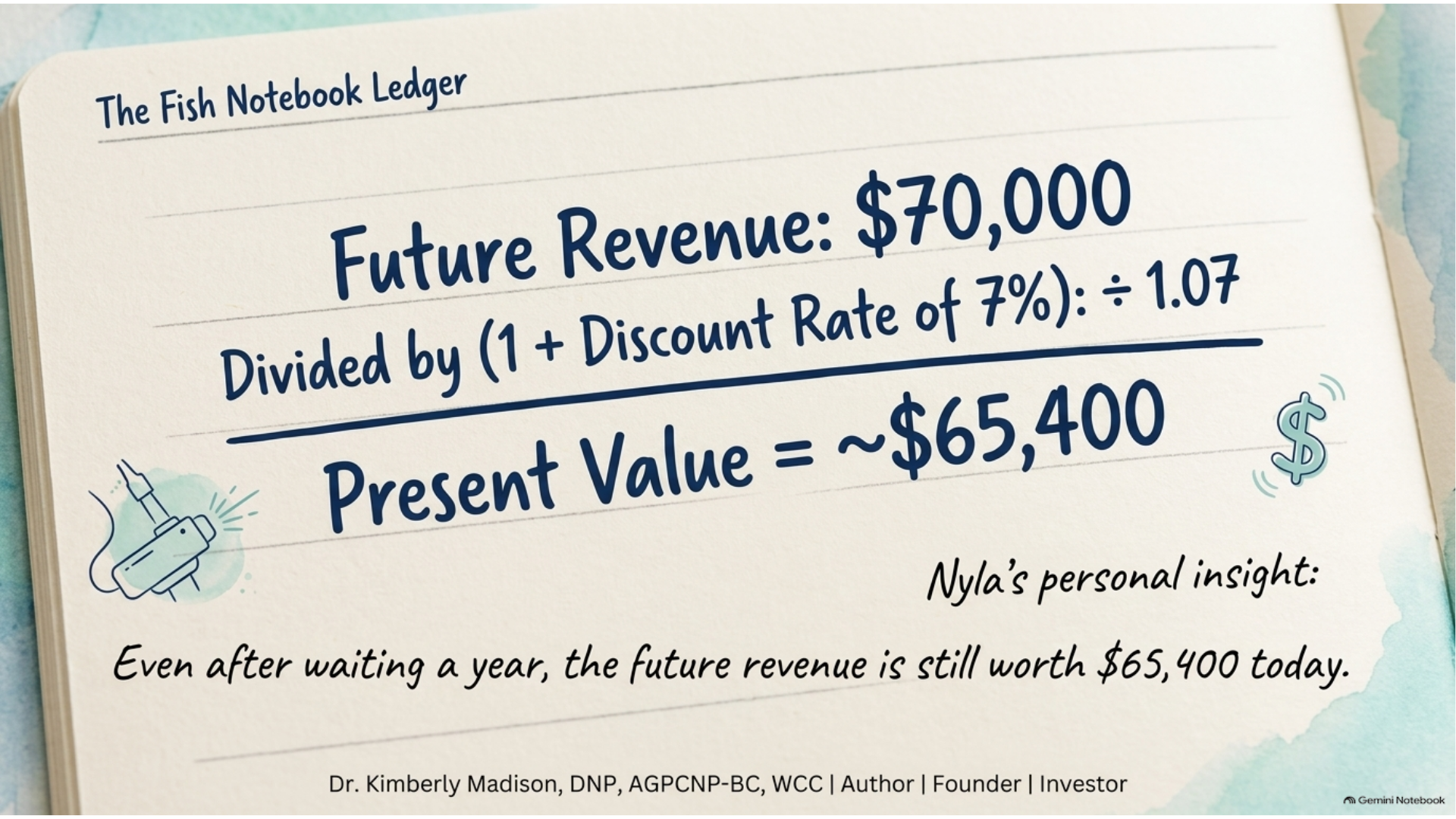
"You use something called a discount factor. Say I could safely invest my money elsewhere and earn 7% a year. To find out what $70,000 next year is worth today, I divide it by 1.07. That gives me around $65,400."
Nyla reached for her notebook, the one with the fish on the cover, and wrote the number down.
"So even after accounting for the fact that I have to wait a year for that money," Dr. Avery, DNP continued, "it's still worth more today than the $60,000 the laser costs. That tells me something. It doesn't tell me everything, but it tells me something."
"What does it tell you?"
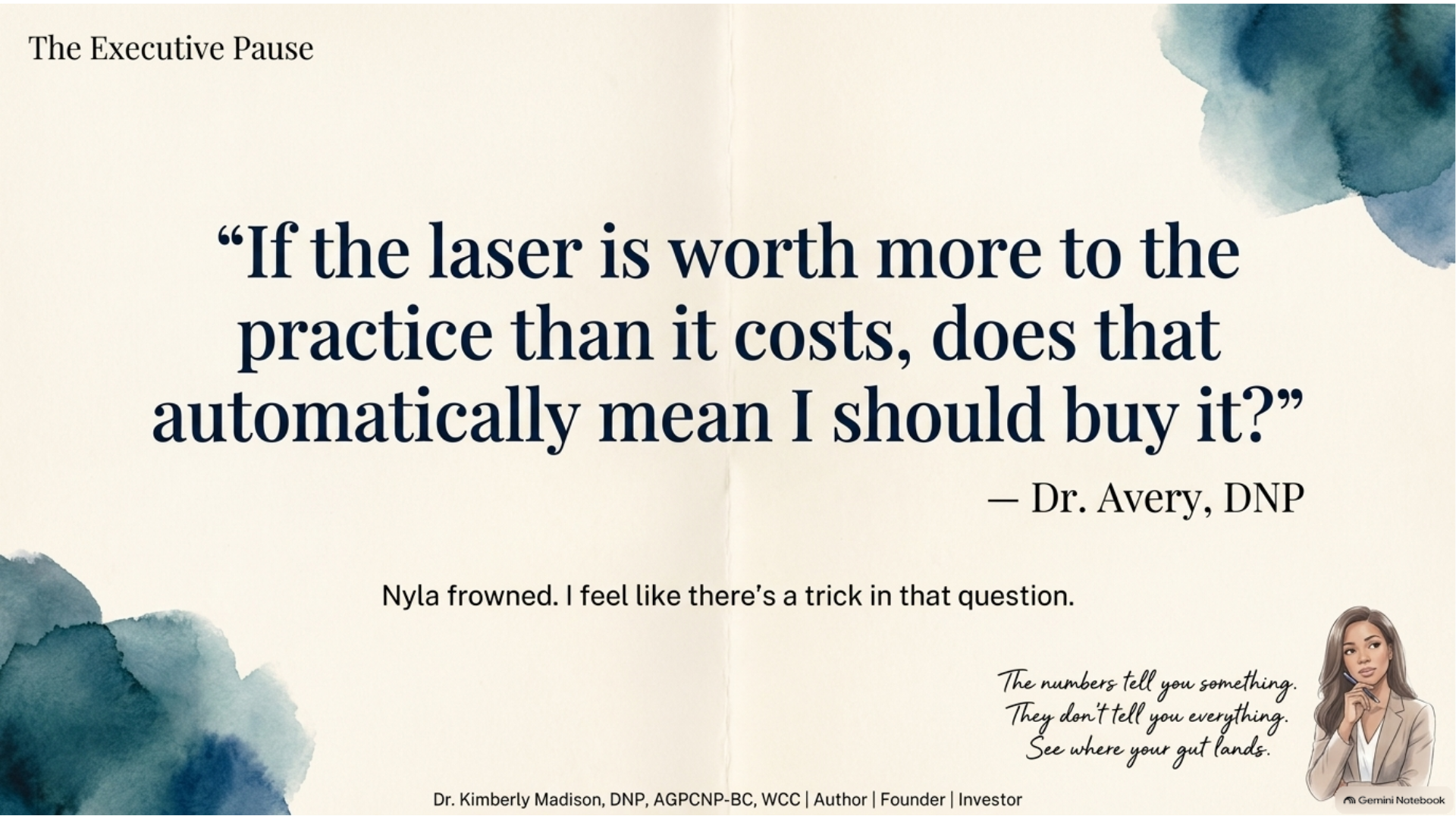
Dr. Avery, DNP closed the folder in front of her. "That's next time's lesson. I want you to think about it between now and then. If the laser is worth more to the practice than it costs, does that automatically mean I should buy it?"
Nyla frowned. "I feel like there's a trick in that question."
"There might be," Dr. Avery, DNP said, smiling. "Go home. Think about the patient you met today, and think about the number. See where your gut lands before I give you the answer."
Nyla left that afternoon with her notebook full and her mind fuller. She thought about the woman with the marks on her arm who had been told to just wait it out, and she thought about $65,400, and for the first time she understood, even just a little, that those two things were not as far apart as they seemed.
Behind this chapter: Post-inflammatory dyspigmentation is one of the most common conditions affecting patients with deeper skin tones, and Mahogany Dermatology Nursing | Education | Research™ was built specifically to close the training deficit around it. The clinical grounding in this chapter reflects the same work laid out in Dr. Kimberly Madison's, DNP, whitepaper,The State of Nursing Education: Pathways, Purpose, and the Future of Cosmetic & Dermatology Practice, which charts a path so the next generation of providers walks in already knowing what to look for. The finance lesson comes from this year's whitepaper,Financial Literacy as a Clinical Competency, built on the premise that a provider who can run the numbers on a $60,000 laser is better positioned to bring better care to more patients, not less.
Nyla is still in high school, but real students are already building their own version of this path. Clarence Sams, MS4, shares his journey as a medical student at Charles R. Drew University on The Melanin Initiative's "Becoming a Physician" series. Ijenna Adibe, a senior at Howard University and founder of the Howard University Undergraduate Society of Dermatology, shared her own path on the same series. Wherever you're starting from, the door is already open.
About the Author
Dr. Kimberly Madison, DNP, AGPCNP-BC, WCC is a Board-Certified, Doctorally-prepared Nurse Practitioner, educator, researcher, and author dedicated to advancing dermatology nursing education with an emphasis on skin of color, business acumen, and digital literacy. She is the founder of Mahogany Dermatology Nursing | Education | Research™ and the Alliance of Cosmetic Nurse Practitioners™, the first dermatology nursing organization in the country built at the intersection of clinical excellence, skin of color care, and financial literacy for nurses. A selected participant in the Harvard Business School Foundry Bootcamp, Dr. Madison continues to sharpen the entrepreneurial infrastructure behind her mission. Through peer-reviewed research, published books, and a growing community of nurse entrepreneurs, Dr. Madison is building the infrastructure that makes this profession sustainable for the people who choose it.
.svg)

.svg)
.svg)