How Hiring Nurse Practitioners Saves Healthcare Organizations $3 Million a Year - And Why Walmart Learned It the Hard Way
Healthcare investors are putting billions into primary care, dermatology, aesthetics, and health AI. Walmart closed 51 health centers in 2024 after five years, and Walgreens took a multibillion-dollar write-down on VillageMD. The missing variable in deals like these is clinical intelligence at the design table, and nurse practitioners hold it. This article covers four things. First, the workforce: more than 461,000 licensed NPs, with an average starting salary of $180,000 compared with $403,000 for physicians. Second, a cost model for a 10-provider team that shows $2.67 million to $3.28 million in modeled annual savings with an NP-led structure. Third, what the Walmart closures teach about reimbursement, labor cost, and community trust. Fourth, the equity structure that puts clinical architects in an ownership position. After reading, you will evaluate a healthcare deal by who designed the care model, not only by the technology and the footprint. You will see NP clinical intelligence as a competitive advantage with a cost structure, a patient base, and community trust you can underwrite.
Four steps you can take this quarter:
Add one question to your diligence framework: where are the nurse practitioners in this structure, and at what level do they inform clinical design?
Run the Model A and Model B cost comparison with your own salary and overhead assumptions.
Score each portfolio company's management team on clinical expertise, using the four criteria in this article.
Offer NPs advisory seats and equity, not staff roles, in the next care delivery deal you structure.
What venture capital and acquisition decision makers are missing about nurse practitioners, and what it is costing them
I have watched surgeons making $800,000 a year who cannot take a week off. I have watched nurse practitioners generating millions in annual revenue for health systems who go home with a salary that does not reflect a dollar of what they produced. I have watched brilliant, disciplined clinicians build practices that fail, because we are not taught that our clinical expertise is an asset class. We are taught to deliver care. We are not taught to own anything.
I have also watched Walmart open 51 health centers over five years and close every one of them in 2024. I watched CVS announce a $10.6 billion deal for Oak Street Health. I watched Walgreens invest more than $6 billion in VillageMD, take a multibillion-dollar write-down, and explore selling its stake. And I watched Walmart cite reimbursement challenges and operating costs as the cause, as if reimbursement complexity is a surprise in healthcare, as if anyone who has ever billed an insurance company, negotiated a collaborating agreement, or managed a clinical practice budget would not have seen every one of those problems coming from the first strategy session.
The variable missing from every one of those deals is the same variable missing from every healthcare portfolio that is underperforming right now. It is not better technology or a larger network. It is clinical intelligence at the ideation table, from the providers who actually deliver the care, who actually know the patients, who actually understand what problems need to be solved. That provider is a nurse practitioner. And we are not a dominant asset in your portfolio.
The workforce numbers your diligence process is missing
Nurses are investors. And we are investable. That is the thesis. Here are the numbers.
There are more than 461,000 licensed nurse practitioners in the United States, according to the American Association of Nurse Practitioners' 2025 count. The Bureau of Labor Statistics projects that employment of nurse practitioners, nurse anesthetists, and nurse midwives will grow 35% from 2024 to 2034, much faster than the average for all occupations. NPs account for more than one billion patient visits every year. We prescribe, diagnose, and manage complex disease states independently in a growing majority of states. We serve disproportionately in underserved communities, rural markets, and among the patient populations with the highest disease burden and the least access to care, the exact populations that every healthcare platform on your portfolio slide is trying to reach to expand your total addressable market.
According to the AMN Healthcare 2025 Review of Physician and Advanced Practitioner Recruiting Incentives, the longest consecutively published and most comprehensive report on physician and advanced practitioner recruiting in the industry, now in its 32nd year, nurse practitioners have been the number one most requested search engagement for five consecutive years. The average starting salary for NPs in 2025 is $180,000, up 9.6% year over year. The average starting salary for physicians across all specialties is $403,000. NPs also cost less to recruit: AMN reports average signing bonuses of $12,869 for NPs and PAs, compared with $38,215 for physicians. NP training is also shorter, typically 6 to 8 years compared with 11 to 15 for physicians.
A 2025 systematic review in Nursing Economic$ (Lee et al.) examined 28 studies on the economic value of NP care to healthcare organizations, as measured by NPs' impact on net operating revenue and the return on the investment costs of building an NP workforce. Across the 16 studies that compared NPs with physicians, all found positive to neutral economic value. Three studies comparing NPs with physician assistants found negative NP value.
The quality evidence reinforces the cost argument. AANP's review of the published research reports that NP care is associated with fewer unnecessary hospital readmissions, fewer potentially preventable hospitalizations, and higher patient satisfaction. Lower cost to recruit. Fewer downstream utilization costs. Positive to neutral economic value across the studies that compare NPs with physicians. That is not a tradeoff. That is the most underleveraged capital efficiency advantage in healthcare.
The cost comparison that closes the argument
The question venture capital and acquisition decision makers need to answer is what the workforce model costs, and what it returns.
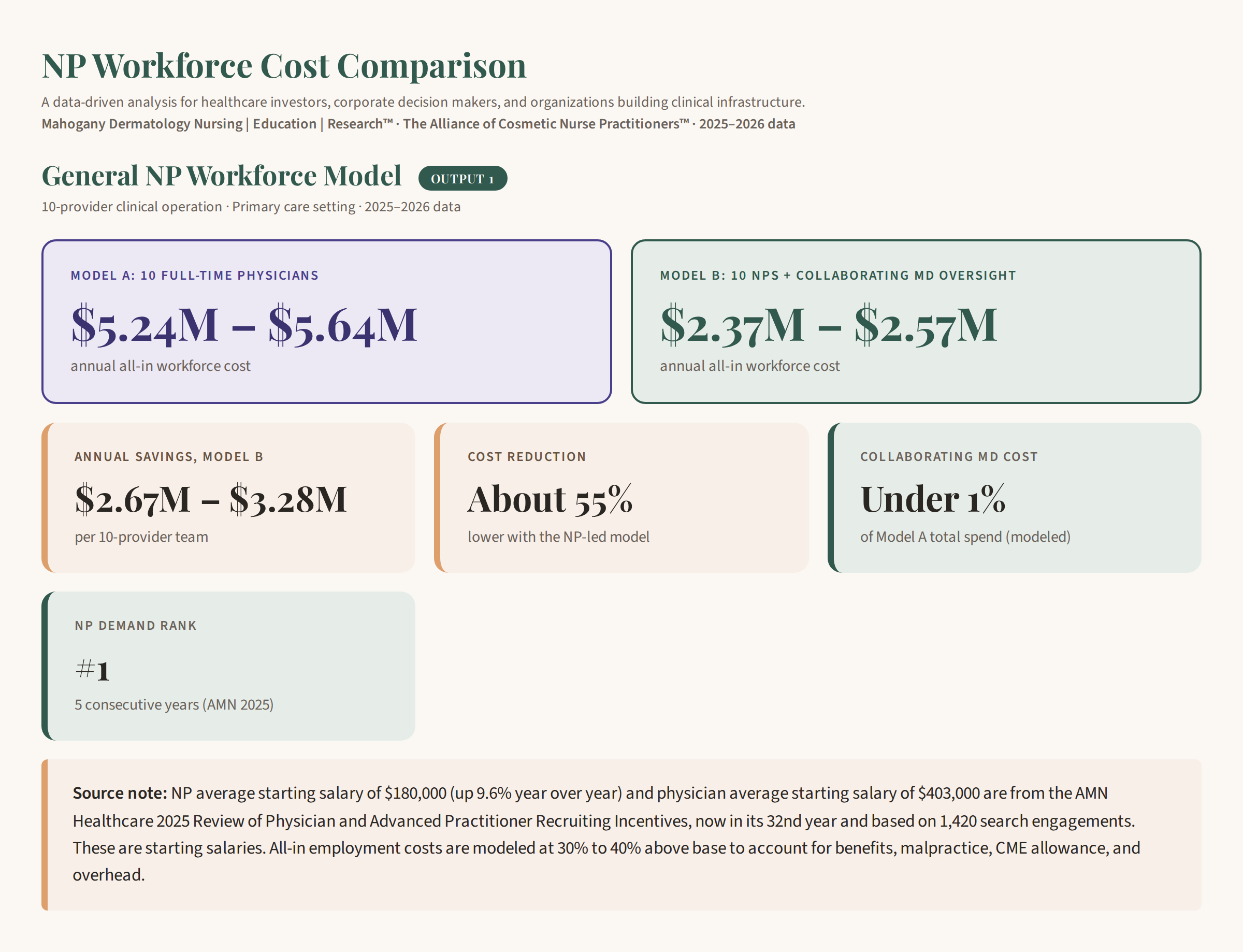
Based on 2025 AMN Healthcare data, the average NP starting salary is $180,000 and the average physician starting salary is $403,000. When all-in employment costs are modeled at 30 to 40% above base to account for benefits, malpractice, CME allowance, and overhead, the total annual cost of employing a single physician runs approximately $524,000 to $564,000. The total annual cost of employing a single NP runs approximately $234,000 to $252,000.
Modeled for a 10-provider clinical operation:
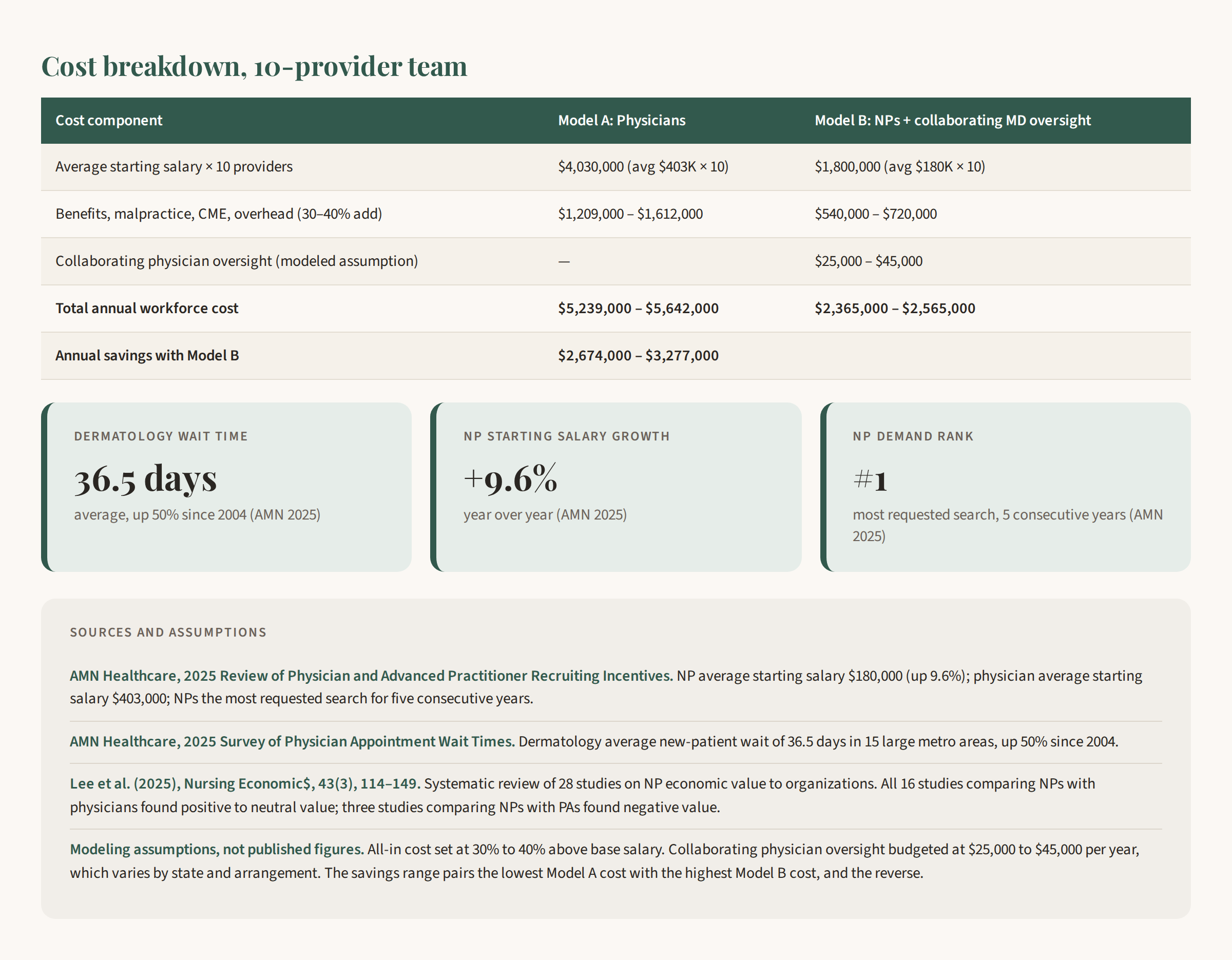
Model A — 10 full-time physicians treating patients: total annual workforce cost $5,239,000 to $5,642,000.
Model B — 10 full-time NPs treating patients, with physicians in a collaborating oversight role only: NP salary and compensation $1,800,000, benefits and overhead $540,000 to $720,000, collaborating physician oversight budgeted at $25,000 to $45,000 annually, an assumption that varies by state and arrangement. Total annual workforce cost $2,365,000 to $2,565,000.
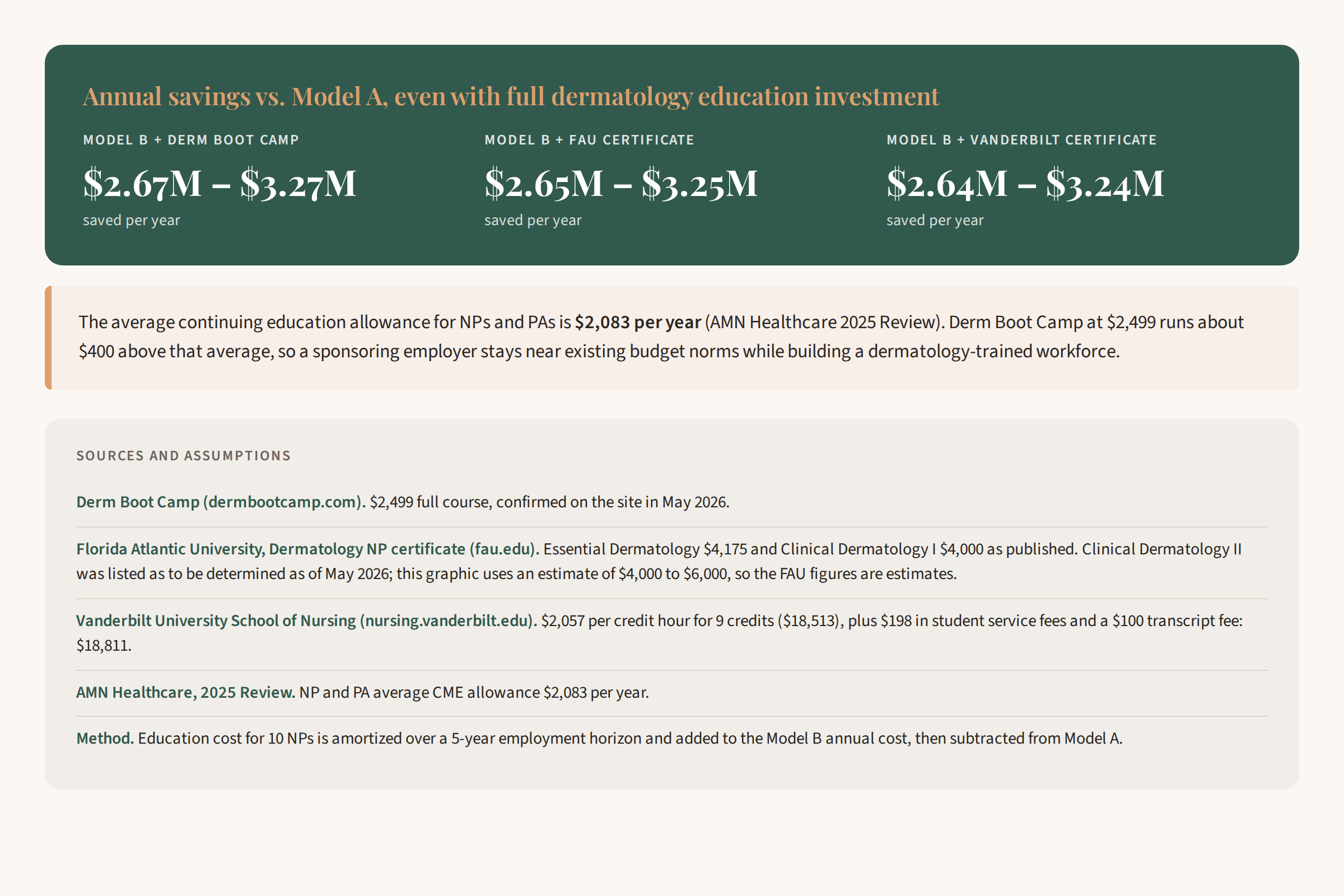
Annual savings with Model B: $2,674,000 to $3,277,000.
That is a workforce model that delivers comparable clinical outcomes, higher new patient volume in primary care, and a cost structure that is more than 50% lower than a physician-only model, with a collaborating physician oversight cost that runs less than 1% of the total Model A spend. For a venture capital firm evaluating a healthcare investment, that differential is not just an operating efficiency story. It is a margin story and it leads to scale. It is the difference between a care delivery model that can sustain itself through the reimbursement headwinds that broke Walmart and a model that cannot.
The model that deploys NPs as the primary care delivery workforce, with physicians in a clinical oversight and quality assurance role rather than a full-time treatment role, is the highest-ROI clinical staffing decision available in healthcare right now. And it is the decision that the companies building healthcare infrastructure at scale have not yet considered at full scale.
The three opportunities
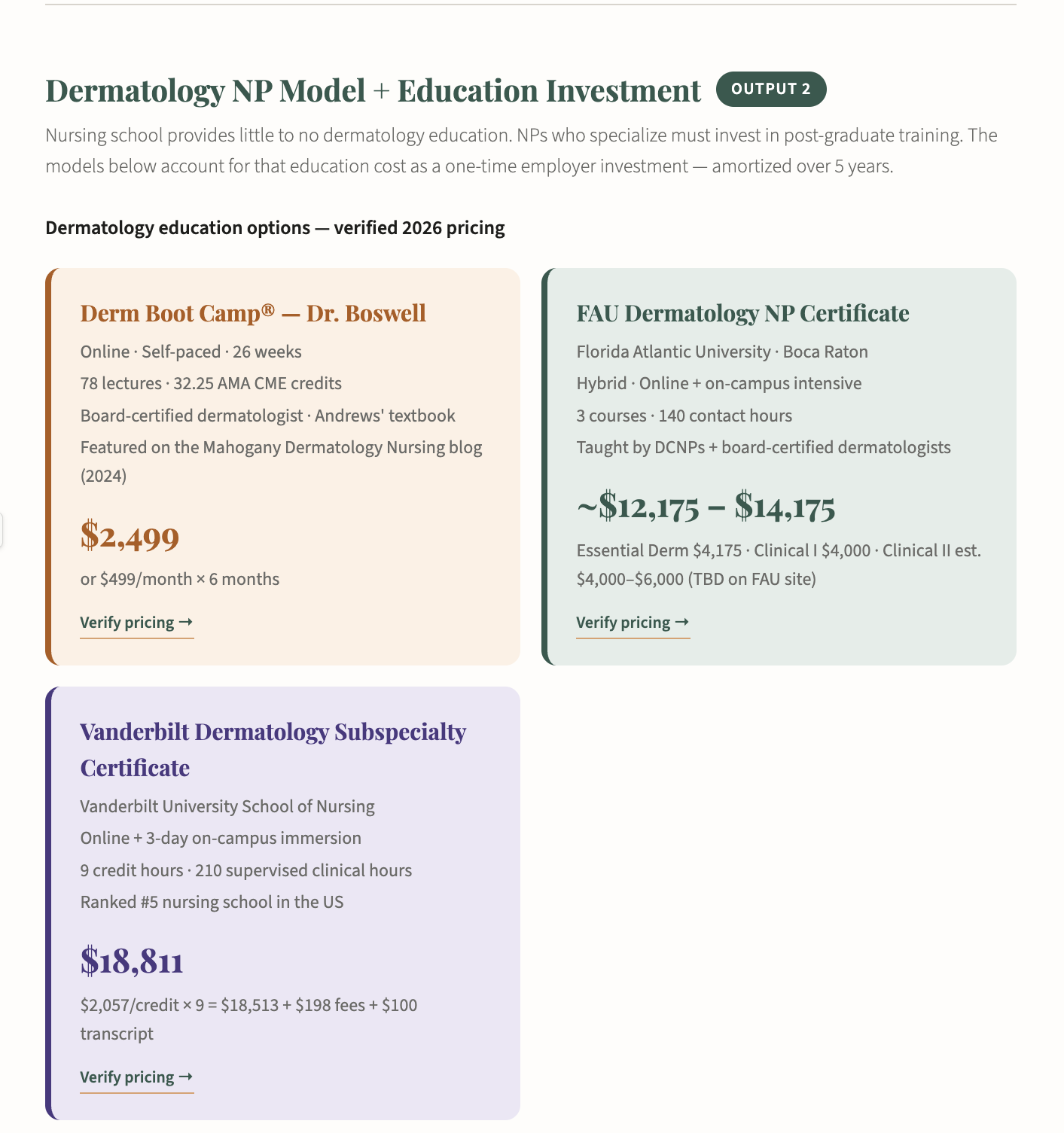
I have spent years identifying three specific opportunities that sit at the intersection of nursing education, dermatology, and entrepreneurship. Nursing school ignores skin of color. Dermatology training ignores entrepreneurship. Cosmetic training does not include advanced nursing practice. Every healthcare platform built in dermatology, aesthetics, primary care, and the fastest-growing specialty, wellness, is building directly into those niches without knowing it.
The skin of color gap is a patient safety issue with a direct financial consequence. Conditions that present differently on diverse skin types are routinely misdiagnosed when the provider was trained on a curriculum built from a single skin tone. When an AI health platform generates guidance for a patient with darker skin based on training data that did not include her presentation, the error shows up as churn, trust erosion, and as the community that was supposed to be your growth market. The NP who has spent a decade treating skin of color in that community is the single most cost-effective solution to that problem.
The limited access to dermatology compounds the skin of color problem. The average time needed to schedule a dermatology appointment in major metropolitan areas is now 36.5 days — up 50% since 2004, according to the AMN Healthcare 2025 Survey of Physician Appointment Wait Times. In communities with fewer physicians per capita, that wait is longer. The NP who has built a dermatology practice in an underserved community is the primary dermatology access point for an entire zip code. The platform that builds around her clinical presence rather than trying to replicate it with a telehealth product gets to that community faster, cheaper, and with more trust than any technology-first solution can achieve.
Clinicians who build sustainable practices understand the economics of care delivery from the inside, reimbursement complexity, scope of practice variation by state, patient population needs assessment, and community trust as a patient acquisition asset. That knowledge comes from building a practice, watching it struggle, fixing what broke, and building again. The NPs who have done that are the clinical architects your healthcare investment needs at the ideation table. They understand what breaks before the capital is deployed rather than after.
Health AI tools have documented accuracy failures in cancer screening, lab value interpretation, and differential diagnosis generation. The platforms that solve this first, by embedding credentialed advanced practice clinicians into their quality assurance architecture, will build the most defensible moat in the category. The platforms that do not will face the regulatory and reputational consequences of getting clinical guidance wrong at scale for patients who had no other provider to catch the error.
The ROI case by investment thesis
General Catalyst manages more than $40 billion in assets and runs a Health Assurance thesis that prioritizes shifting healthcare from reactive treatment to proactive and preventive care. Its HATCo arm closed the $515 million acquisition of Summa Health in 2025, making Summa the first health system wholly owned by a venture capital firm. a16z Bio and Health is investing in the underlying systems that support data exchange, interoperability, and the infrastructure of modern healthcare. JPMorgan's Morgan Health division is making direct balance sheet investments in late-stage healthcare ventures with demonstrable market fit and scale, most recently co-leading a $30 million round in Lantern, a specialty care platform serving 12 million people.
Every one of these firms is building healthcare infrastructure. None of them are building it with nurse practitioners at the advisory table, in the C-suite, or in the ideation room. And the absence is showing up the same way it showed up in every retail healthcare failure: as a slow accumulation of design problems that compound until the model breaks.
The digital health platform that embeds NP clinical expertise into its patient acquisition strategy is acquiring patients through existing community trust at near-zero direct cost. Reported patient acquisition costs in 2026 run from about $155 in pediatrics to $610 in cosmetic surgery (First Page Sage).
The NP who has practiced in a community for a decade has already acquired those patients. The platform that deploys her intelligence, rather than trying to replicate it with a marketing budget, does not compete on The NP who has practiced in a community for a decade has already acquired those patients. The platform that deploys her intelligence, rather than trying to replicate it with a marketing budget, does not compete on customer acquisition costs (CAC). It competes on trust, which is the only moat in healthcare that compounds.
The health AI platform that builds NP clinical review architecture into its quality assurance layer is building a credentialing infrastructure that its competitors will spend years trying to replicate after the regulatory environment forces the issue. The firms that get there first will own the category.
The primary care and care delivery platform that puts NPs at the strategy level, not as staff, but as advisors, equity holders, and ideation partners, is the platform that will not replicate the Walmart failure. Because the NP in that room will name every design flaw before the capital is deployed rather than after the losses are realized.
What Walmart's failure actually cost, and what DNP-prepared NPs would have changed
Walmart spent five years on a healthcare model that did not have to fail the way it did. That is the pain. Not the closure announcement. Not the press release language about challenging reimbursement environments. Five years. Fifty-one clinics. Every clinician they hired to staff them. And a community health access problem that got larger the day they locked the doors.
Walmart has everything. It has $713 billion in annual revenue, more than 10,900 stores across 19 countries, approximately 280 million weekly customers, and one of the most recognized brand names in the world. If any company had the resources to make primary care work at scale in this country, it was them. And they still failed because the model was designed without the people who understand how healthcare actually works at the point of care.
The company cited a challenging reimbursement environment and escalating operating costs as the cause. Payer mix, service line selection, and staffing strategy look like market conditions from the outside, but each one is a design decision made before the first clinic opens.
And every one of them has a direct solution in the competency set of a doctorally prepared, financially literate nurse practitioner at the strategy table where the model was being built.
Reimbursement architecture. The DNP-prepared NP who has run a practice understands reimbursement as a daily operational reality. She knows which CPT codes generate sustainable margins. She knows which payer mixes make a primary care model viable in a specific zip code. She knows which services hold up on a cash-pay basis and which collapse the moment you scale them. She knows how to structure a service line mix that generates revenue across multiple reimbursement pathways simultaneously: insurance, self-pay, employer partnerships, and pharmacy benefit integration. A Walmart spokesperson said reimbursement was challenging from all types of insurance. A DNP-prepared NP or nurse with practice ownership experience models payer mix and service line margins in the first strategy session, not in the fifth year.
Labor cost strategy. Walmart cited escalating operating costs as a reason it closed its health centers. The average NP starting salary is $180,000, compared with $403,000 for physicians (AMN Healthcare 2025), and the Bureau of Labor Statistics projects 35% employment growth for nurse practitioners, nurse anesthetists, and nurse midwives combined from 2024 to 2034. A workforce strategy built around NP employment rather than physician employment reduces labor cost before it becomes a closure decision.
But that decision requires someone at the strategy table who understands scope of practice legislation by state, the relationship between full practice authority and operational cost, and how to build a clinical staffing model that is sustainable across the reimbursement environment of each market. That is not a healthcare administrator. That is an NP with financial literacy and operational experience. Walmart never had one in that room.
Community trust as a patient acquisition asset. Retail traffic does not convert automatically into healthcare utilization. Healthcare decisions are trust decisions. The patient who buys groceries at Walmart does not automatically trust Walmart with her primary care. That trust has to be built through providers, through community presence, through relationships that develop over time and across encounters. The NP who has practiced in a community for a decade has already built that trust. Her community presence is the patient acquisition infrastructure that no amount of capital can replicate on a timeline that a retail healthcare model can sustain. Embedding her into the model as a strategic partner with equity in the outcome, not a staff member with a salary, changes the patient acquisition calculus before a single clinic opens.
The re-entry case, and the equity structure it requires.
Walmart still operates 4,600 pharmacies and more than 3,000 vision centers. It still serves 255 million weekly customers. The infrastructure exists. The community presence exists. The patient relationships exist through pharmacy, which is the highest-frequency healthcare touchpoint most patients have. What does not yet exist is the clinical strategy layer that connects that infrastructure to a sustainable care delivery model.
The re-entry model is not another primary care network. It is a pharmacy-anchored, NP-led care model built specifically for the reimbursement environment, patient population, and scope of practice landscape of each state Walmart operates in. It is designed by DNP-prepared NPs and nurses with practice ownership experience and financial literacy, not by consultants who have studied the market from the outside, but by providers who have built sustainable clinical businesses inside the exact communities Walmart is trying to serve.
An NP who enters a re-entry partnership as a strategic equity holder, has a fundamentally different relationship to the outcome. Her incentive is aligned with sustainability. Her decision-making is grounded in clinical integrity, not volume targets. Her community trust is an asset she brings to the partnership rather than a resource the company tries to manufacture through marketing. Equity is finite. How it is allocated in the re-entry model determines whether the clinical intelligence that makes the model work stays in the room or walks out the door when the salary stops being competitive.
That is the investment thesis. The model exists. The workforce exists. The community infrastructure exists. What has never existed is the capital structure that puts the right clinical architects in the right ownership position to build it correctly. And that is where the return is.
The management team criterion you are not applying
The management trust framework Brandon Bryant, co-founder of VC firm Harlem Capital, applies to every business decision evaluates organizations on four criteria: the quality and expertise of the management team, the velocity with which the organization moves toward the right solution, the ability to hire from centers of excellence and retain top talent, and the capacity to productize unique unfair advantages.
Apply that framework to every healthcare investment you are evaluating. Score the management team on clinical expertise and the ability to design a care delivery model that works for the patient populations being served because the designers have actually delivered that care. If the clinical advisory structure of that investment does not include nurse practitioners, you have a management team gap that will surface in your outcomes data.
The retail healthcare failures of the last five years were not fast failures. They were slow, expensive failures that took years and billions of dollars to surface because the clinical design problems were invisible to the people making the decisions. Velocity toward the right solution requires knowing what the right solution looks like. That knowledge lives in the providers who have built and rebuilt clinical models in underserved markets, NPs who have run practices, managed staff, negotiated collaborating agreements, and watched what breaks when the clinical infrastructure is not built correctly from the start.
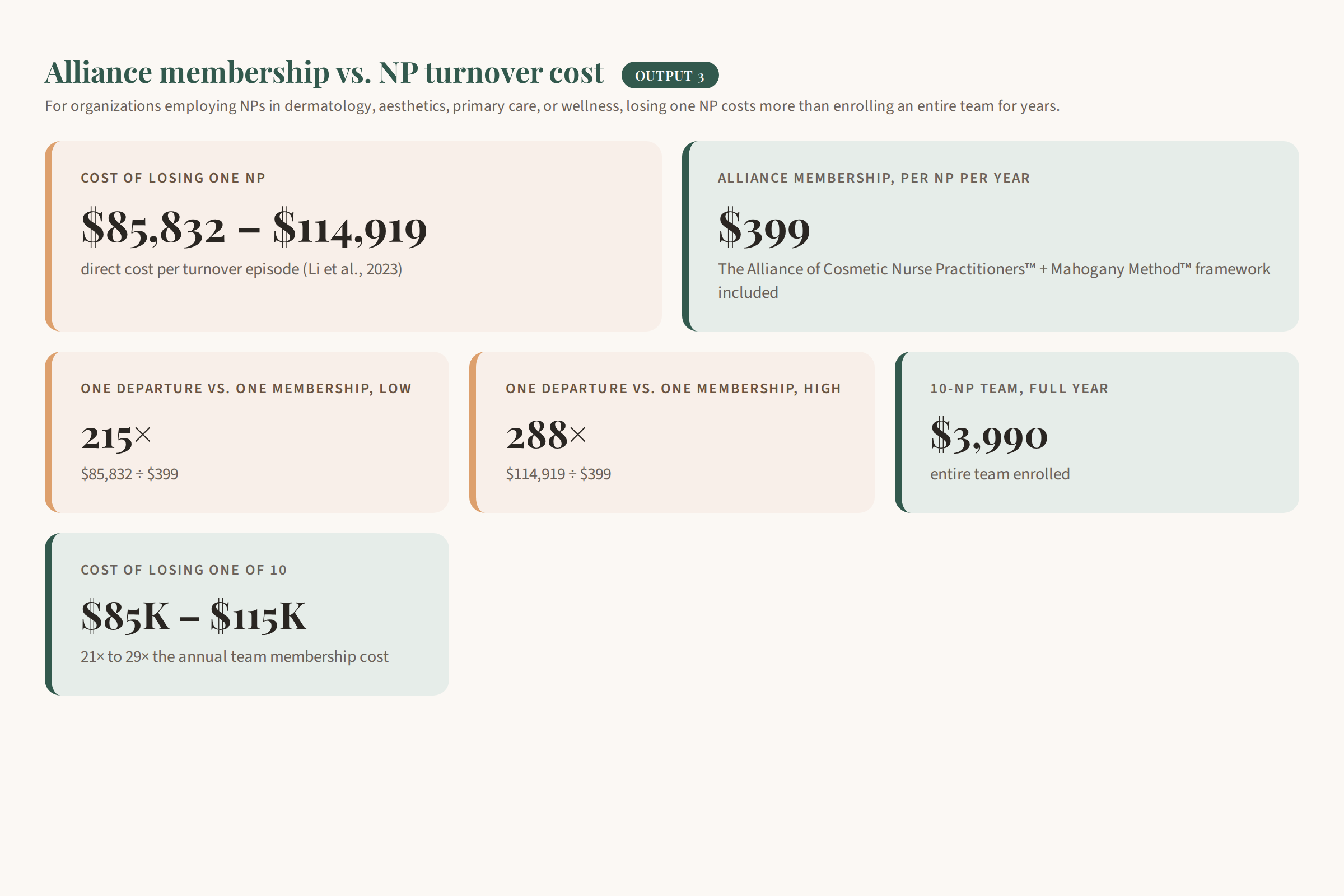
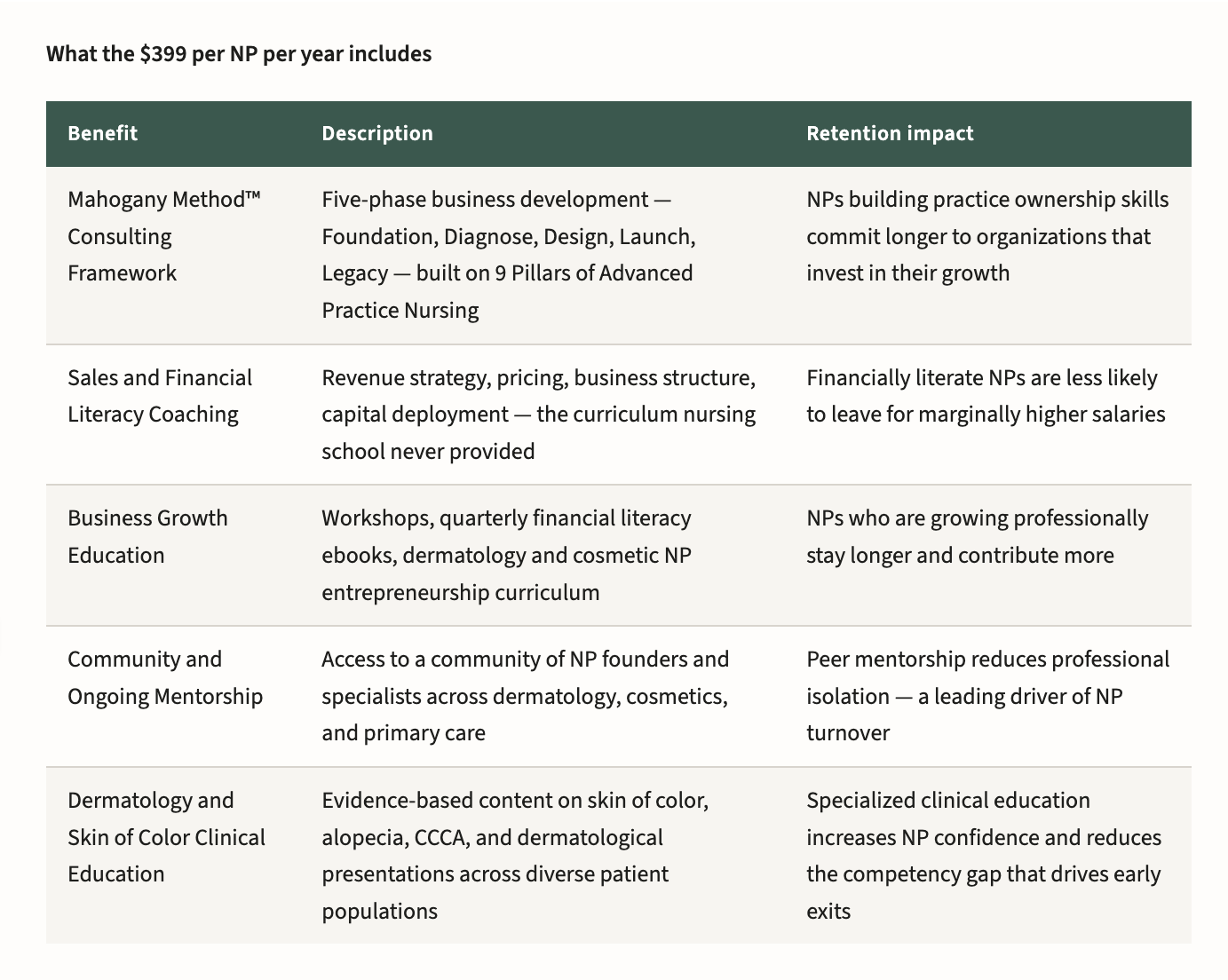
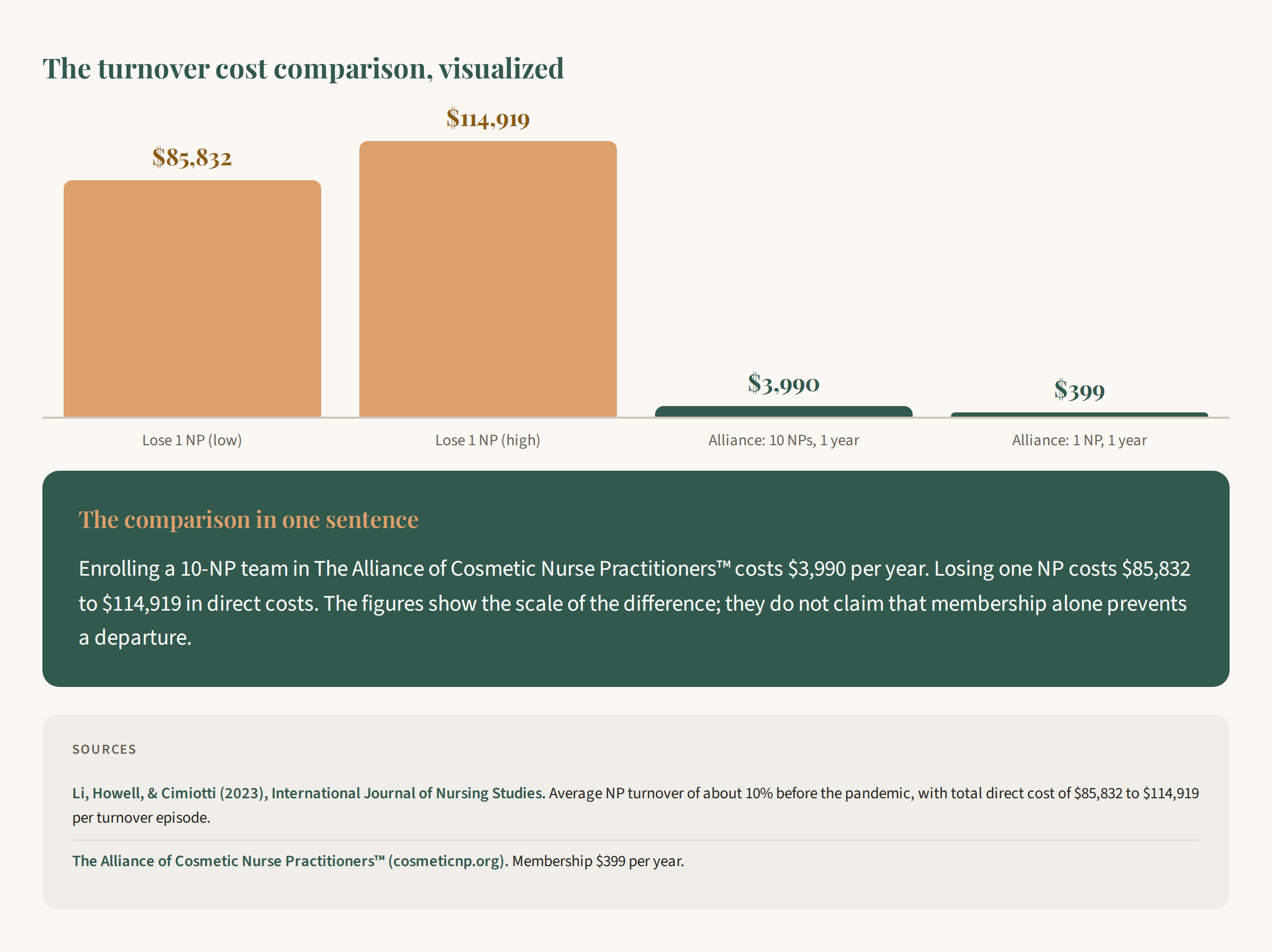
Hire from centers of excellence and retain top talent means hiring from the workforce closest to the problem. In healthcare the problem is access, trust, clinical accuracy, and community-specific intelligence. The workforce closest to all four is nurse practitioners. Not as a diversity initiative or community relations function. But, as a talent acquisition strategy with a direct return on capital. Before the pandemic, the direct cost of losing one NP ran $85,832 to $114,919 per turnover episode (Li, Howell, and Cimiotti, 2023). The cost of keeping that NP enrolled in ongoing business growth and financial literacy coaching through The Alliance of Cosmetic Nurse Practitioners™ is $399 per year. The organization that understands that ratio treats retention support as a competitive infrastructure advantage.
The unfair advantage that is sitting underpriced in this market right now is the clinical intelligence that NPs carry about the communities these platforms are trying to serve. It is not in a database or training dataset. It is in a decade of patient relationships, community trust, and point-of-care decision-making that no algorithm has fully encoded. The platform that productizes that intelligence before its competitors do will build a moat that is genuinely difficult to replicate and impossible to acquire at current market rates.
The ask
In 2025, 52,498 applicants registered for the Main Residency Match and competed for 43,237 positions, according to the National Resident Matching Program. The physician shortage is structural, compounding, and not solvable within the investment horizon of any fund currently deploying capital into healthcare. The Bureau of Labor Statistics projects that employment of nurse practitioners, nurse anesthetists, and nurse midwives will grow 35% from 2024 to 2034. NPs carry full practice authority in more than half of U.S. states and the District of Columbia, and we are one of the few scalable clinical workforce solutions available within a 3 to 5 year deployment window.
The next time your firm evaluates a healthcare investment, add one question to your diligence framework. Where are the nurse practitioners in this organizational structure and at what level are they informing the clinical design? If the answer is staff, or absent, you have identified the design flaw before the capital is deployed rather than after.
The firms that get this right first will build the most defensible clinical infrastructure in a sector where trust is the only moat that compounds. And they will do it with the highest-ROI clinical workforce in the country, one that has been generating returns for health systems, pharmaceutical companies, and healthcare platforms for decades without receiving equity, without sitting at the advisory table, and without being invited into the ideation room.
That changes now. Nurses are investors. And we are investable.
About the Author
Dr. Kimberly Madison, DNP, AGPCNP-BC, WCC, is a Board-Certified, Doctorally-prepared Nurse Practitioner, educator, researcher, and author dedicated to advancing dermatology nursing education with an emphasis on skin of color, business acumen, and digital literacy. She is the founder of Mahogany Dermatology Nursing | Education | Research™ and the Alliance of Cosmetic Nurse Practitioners™, the first dermatology nursing organization in the country built at the intersection of clinical excellence, skin of color care, and financial literacy for nurses. A selected participant in the Harvard Business School Foundry Mindset Bootcamp, Dr. Madison continues to sharpen the entrepreneurial infrastructure behind her mission. Through peer-reviewed research, published books, and a growing community of nurse entrepreneurs, Dr. Madison is building the infrastructure that makes this profession sustainable for the people who choose it.
References
AMN Healthcare. (2025a). 2025 review of physician and advanced practitioner recruiting incentives.
AMN Healthcare. (2025b). 2025 survey of physician appointment wait times and Medicare and Medicaid acceptance rates.
First Page Sage. (2026). Average patient acquisition cost: 2026 report.
Fierce Healthcare. (2024). Walgreens may sell entire stake in VillageMD business as it explores strategic options.
Pifer Parduhn, R. (2023, March 1). Oak Street Health posts $510M loss, outlines risks to CVS acquisition. Healthcare Dive.
Pifer Parduhn, R. (2025, October 1). General Catalyst's HATCo finalizes Summa Health acquisition. Healthcare Dive.
Lantern. (2026, March 19). Lantern secures $30M strategic investment from Morgan Health and Echo Health Ventures to help employers reduce costs and improve outcomes for specialty care [Press release].
Lee, K., et al. (2025). The economic value of nurse practitioners to US health care organizations: A systematic review. Nursing Economic$, 43(3), 114–149.
Li, Y., Howell, J. R., & Cimiotti, J. P. (2023). Nurse practitioner job preference: A discrete choice experiment. International Journal of Nursing Studies, [volume(issue), pages].
National Resident Matching Program. (2025, March 21). National Resident Matching Program releases the 2025 Main Residency Match results, celebrates the next generation of physicians [Press release].
News4JAX. (2024, April 30). Walmart to close its 51 health centers and virtual care service.
Private Equity Wire. (2026). General Catalyst discusses raising $10bn across multiple funds.
U.S. Bureau of Labor Statistics. (n.d.). Nurse anesthetists, nurse midwives, and nurse practitioners. In Occupational outlook handbook. Retrieved October 1, 2026.
Walmart Inc. (2024, April 30). Walmart Health is closing [Press release].
Walmart Inc. (2026). Form 10-K for the fiscal year ended January 31, 2026. U.S. Securities and Exchange Commission.
.svg)

.svg)
.svg)