What Is Not on the Label: Hair Products, Scarring, and the Questions That Deserve Answers
In the Study of Environment, Lifestyle, and Fibroids, 34% of Black women reported using hair relaxers or straighteners two or more times a year by age 10, and 73% by age 15. The labels on those products leave most of the chemicals of concern unmentioned in the products researchers have tested, and scientists are now asking whether those exposures play a part in fibroids, keloids, and a scarring hair loss called CCCA. Those questions go to the stage on Saturday, November 7, 2026, at the California Black Health Network's virtual summit, Spreading the Beauty Truth, and registering before Friday, October 30 enters you for a chance to win $100.
Black Women Start Using These Products Early and Use Them Often
Hair care for Black women begins early and repeats often. Convenience, aesthetic preference, and beliefs about what counts as professional shape it, along with workplace and school pressure to conform to Eurocentric styles (Schildroth et al., 2024). In the Study of Environment, Lifestyle, and Fibroids, known as SELF, a cohort of Black women around Detroit, use of relaxers or straighteners two or more times a year was 9% at age 5, 34% at age 10, and 73% at age 15 (Gaston et al., 2020, as summarized by Schildroth et al., 2024).
Extensions add to the exposure. In 2022, 34% of adult Black female internet users in the United States said they had worn braids with synthetic extensions in the previous three years, and synthetic braids were the second most popular hairstyle among Black women ages 18 to 34. The global wig and extension market is projected to pass $19.12 billion by 2028, with Black women in the United States and continental Africa as the largest group of buyers, and extensions are typically worn for at least four to six weeks (Thomas, 2023).
Four terms come up throughout the research. Endocrine-disrupting chemicals are substances that interfere with the body's hormones. Fibroids are common, non-cancerous tumors that grow in the uterus and depend on hormones. Keloids are raised scars that grow beyond the original wound. Central centrifugal cicatricial alopecia, or CCCA, is a scarring hair loss that starts at the crown of the scalp and spreads outward, and its prevalence is estimated at up to 5.6% (Malki et al., 2019). Thomas (2023) notes that Black women already face high rates of endocrine disorders, breast cancer mortality, and uterine disease, which is why researchers are asking whether chemicals in hair and beauty products add to that burden.
Researchers Are Finding Chemicals of Concern That Labels Leave Out
The ingredient list is the first place most of us look, and the research shows it is incomplete. Johnson and colleagues (2022) reviewed the ingredient labels of 546 hair, skin, makeup, nail, deodorant, perfume, and intimate care products from stores in three California communities where Black, Latina, and Vietnamese women shop. Over half of the products contained ingredients linked to cancer, reproductive or developmental harm, or endocrine disruption. Of the labels, 74% listed undisclosed ingredients under the single word "fragrance," and laboratory testing of a subset of products found additional chemicals that were not on the labels.
Hair products show the same pattern. A 2018 study of 18 hair products used by Black women tested for 66 chemicals linked to hormone disruption and asthma, and 84% of the chemicals detected were not listed on the label (Helm et al., 2018). The sample was small, and the authors described it as a first step. Front-of-bottle claims do not fill the space either. Neither the United States nor the European Union legally defines "clean" or "natural" for cosmetics, and in a 2016 analysis of 174 best-selling moisturizers, 15 of the 18 products that claimed to be hypoallergenic held at least one common contact allergen (Xu et al., 2017).
Synthetic braiding hair adds its own questions. Kanekalon, a popular synthetic fiber, is a modacrylic made from acrylonitrile and vinyl chloride. The Environmental Protection Agency classifies acrylonitrile as a probable human carcinogen, and the National Cancer Institute links vinyl chloride to leukemia, lymphoma, and rare liver, brain, and lung cancers (Thomas, 2023). Workplace exposure limits for both chemicals are set over an eight-hour period, and Thomas (2023) reports that braiding a full head of hair involves about 800 grams of modacrylic fiber worn for up to six weeks. Consumer Reports tested 10 popular synthetic braiding hair products and reported multiple carcinogens in all of them. A 2026 study tested 43 hair extension products, both synthetic and bio-based, and found that all but two contained hazardous chemicals, including 17 chemicals related to breast cancer across 36 of the products (Franklin et al., 2026).
Two studies from the National Institutes of Health look at what hair straightening may mean for the body. In the Sister Study, women who used straighteners frequently had a hazard ratio of 2.55 for uterine cancer, which means a higher rate of that cancer over the follow-up period, and the study did not collect brands or ingredients, so it could not name a causal ingredient (Chang et al., 2022). The authors of a 2025 fibroid study in Environmental Health Perspectives followed 4,162 Black women and wrote that straightener use may be positively associated with fibroid risk. They asked readers to interpret the results with caution, because the range of possible results for the full group included no effect, fibroid diagnoses were self-reported, and every participant had a sister with breast cancer (Ogunsina et al., 2025).
The biology of CCCA is still being mapped. A 2019 New England Journal of Medicine study found mutations in the PADI3 gene in 14 of 58 women with CCCA, or 24%. PADI3 helps build the hair shaft, and the authors note that the disease usually shows up after intense hair grooming (Malki et al., 2019). A study of scalp tissue from five patients found that genes involved in fibroproliferative disorders, which are conditions of excess scarring, were upregulated in CCCA (Aguh et al., 2018). Whether CCCA shares that biology with fibroids is not settled. A single-center review of more than 487,000 Black women found that 14% of women with CCCA had a history of fibroids, compared with 3% of Black women without CCCA (Dina et al., 2018), while a later matched cohort of 427 women with biopsy-proven CCCA found no association with fibroids or several other fibroproliferative conditions.
The wording matters in every study above. They show that chemicals of concern are present, that some exposures are associated with disease, and that the shared biology of CCCA, fibroids, and keloids is an open question. They do not show that any product causes fibroids, keloids, or CCCA.
Our Hair Care Has a Long and Documented History
The habits behind these numbers did not start with one product. The NIH authors of the 2025 fibroid study trace them back through the last century. Before the 1940s, straightening meant a hot iron and a petrolatum or mineral oil ointment, and the authors note that it caused burns and hair loss. Chemical relaxers arrived around 1940 with sodium and potassium hydroxide, which led to severe chemical burns and hair damage. The 1950s added a mineral oil and petrolatum cream base, and scalp burns continued because the chemicals are corrosive. The Black Power movement of the late 1960s and 1970s brought a return to natural styles and shorter-contact products, and the authors suggest that this period may have meant less exposure. Relaxers for home use arrived in the 1970s, and keratin and Brazilian keratin treatments later added formaldehyde or formaldehyde-releasing chemicals.
The timeline lines up with the fibroid results. In the 2025 study, the link between straightener use and young-onset fibroids was weaker among women born between 1946 and 1964, who came of age as natural styles returned, and stronger among women born earlier and later. The authors describe this as a possible explanation, and they do not present it as proof. They also name why many of us still straighten: the cost of caring for natural hair, the belief that relaxed hair is easier to manage, pressure to meet dominant beauty standards, and a shortage of salons that specialize in natural Afro-textured hair.
One clinician's own timeline fits the same pattern. Dr. Kimberly Madison wore human and synthetic braiding hair sealed with heat or hot water from elementary school through college, received her first perm in middle school and her last in 2003 after losing a significant portion of her hair, and then wore weaves for six years. She stopped covering her natural hair in 2009 and began locking it in June 2017. She credits the Black women who built the natural hair community, including the founder of the Black Girl with Long Hair blog, for what she knows about caring for natural hair, and she began sitting on the Hair For You Advisory Board at Children's National Hospital in 2024. The board is part of an American Nurses Association grant program that supports the first nursing research efforts to establish competencies for assessing the hair and scalp.
Hair choices are made inside real pressures, and the research is asking about the products, not about the people who use them.
Patients and Providers Can Ask Better Questions Together
For those of us at the point of care, the research changes the history we take. Dermatology, women's health, and primary care nurse practitioners can add questions about hair product use to every history, especially for patients with hormonal imbalances, reproductive health concerns, or chronic illness. A full product history covers shampoos, relaxers, straighteners, extensions, natural products, and essential oils, because a clean-looking ingredient list does not rule out a product as a trigger.
CCCA deserves a place on the differential for a Black woman with progressive hair loss at the crown, before anyone assumes female pattern hair loss. The scalp can look quiet while scarring advances, because the fibrosis in CCCA can progress at a rate out of proportion to visible inflammation (Araoye et al., 2020), and follicles replaced by scar tissue do not come back. A scalp biopsy can confirm the diagnosis when the picture is unclear, and each earlier question moves a diagnosis earlier.
The conversation about hair care works best without blame. Telling a patient to stop wearing braids ignores the social, economic, and cultural reasons behind the style, and it damages trust. Better questions ask what matters most about the current routine and which changes the patient is willing to try, such as lower braid tension, more space between relaxer applications, low-manipulation styles, and less heat. Photographs at every visit and a record of the grade of hair loss make progress visible to both sides.
Careful words protect that trust. The studies above show associations and the presence of chemicals of concern, and none of them shows that a product caused a condition. Providers can tell patients what the research found, name what it did not find, and avoid both alarm and dismissal. Patients, in turn, can treat questions as a form of care by asking what a product contains, what a hair extension is made of, and whether the maker lists every ingredient.
The research agenda is moving as well. The Fibroid-Keloid-CCCA Research Initiative, an interdisciplinary team that includes Dr. Kimberly Madison, is asking whether chemical exposures and shared scarring biology connect all three conditions. Nurses and nurse practitioners can help by taking part in registries and surveys, documenting treatment responses, and supporting policy that increases transparency in product labeling.
Five Small Steps Put Us in Charge of the Questions
Start with a photo. Before the next product goes into the cart or onto the scalp, photograph the front of the bottle and the full ingredient list. The picture gives you something to check later, and it gives your care provider something specific to look at.
Next, ask an AI tool to explain the ingredients in plain words and to give you links to the original research behind each claim. Then click every link and confirm that the source says what the tool says it does. A summary is a starting point, and the study it points to is the evidence.
Then shrink the pile, because fewer products mean fewer exposures. A fragrance-free claim is a starting point and not a guarantee, since 18 of the 40 products claiming fragrance-free in the 2016 moisturizer analysis still held a fragrance cross-reactor or botanical ingredient (Xu et al., 2017). Use starts as early as age 5 in the SELF data, so the same steps apply to the products we choose for children's hair. In the 2018 hair product study, relaxers marketed to children carried the highest levels of five chemicals that the European Union prohibits or California regulates (Helm et al., 2018).
For extensions and braids, ask what the hair is made of and whether the maker lists its chemicals. The 2026 study found chemicals of concern in human hair and silk products as well as synthetic ones, and the only two products without hazardous chemicals carried "non-toxic" claims (Franklin et al., 2026). A claim on the package is a good reason to ask more questions, and it does not replace an ingredient list. Stylists and braiders handle these products every day, which makes them partners in this work, and the questions belong to all of us.
Finally, bring one page to your next appointment. Write down the products you use most, the styles you wear, and any scalp burning, thinning, or tenderness you have noticed, and hand it to your provider. A one-page summary turns a rushed visit into a real conversation about what is in your routine, and it gives a provider the chance to look for scarring hair loss while follicles can still be saved.
Register Before October 30 for the Beauty Truth Summit
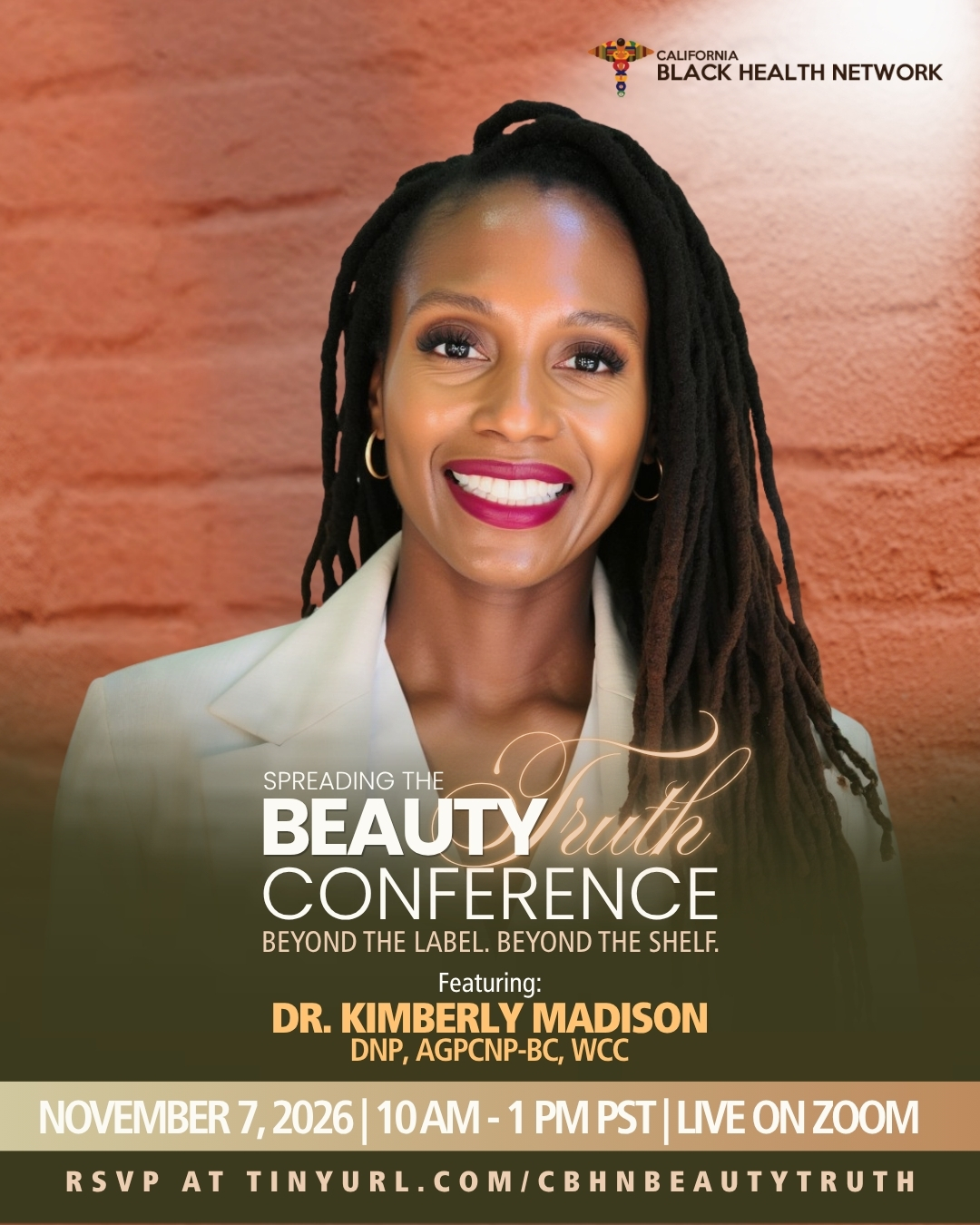
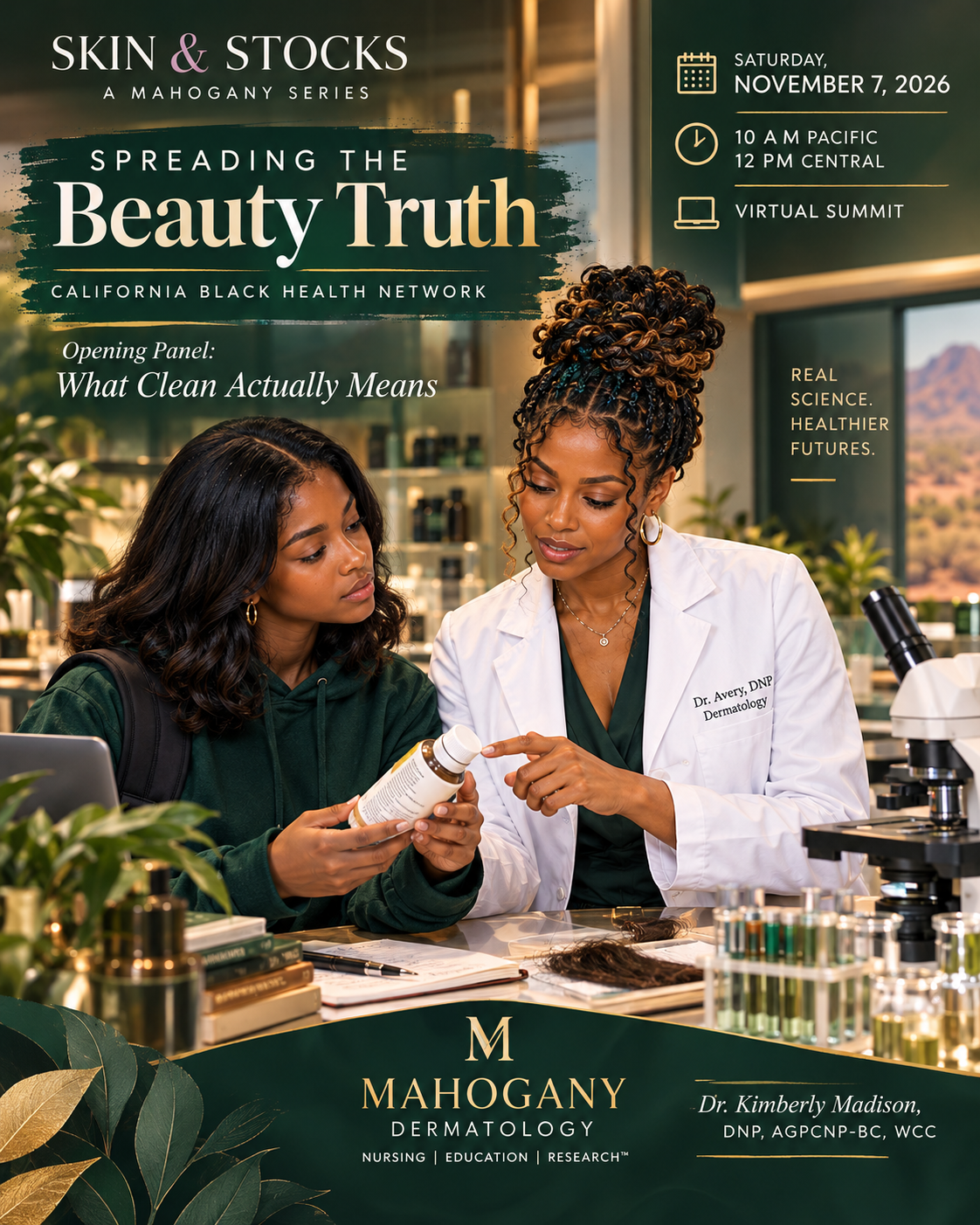
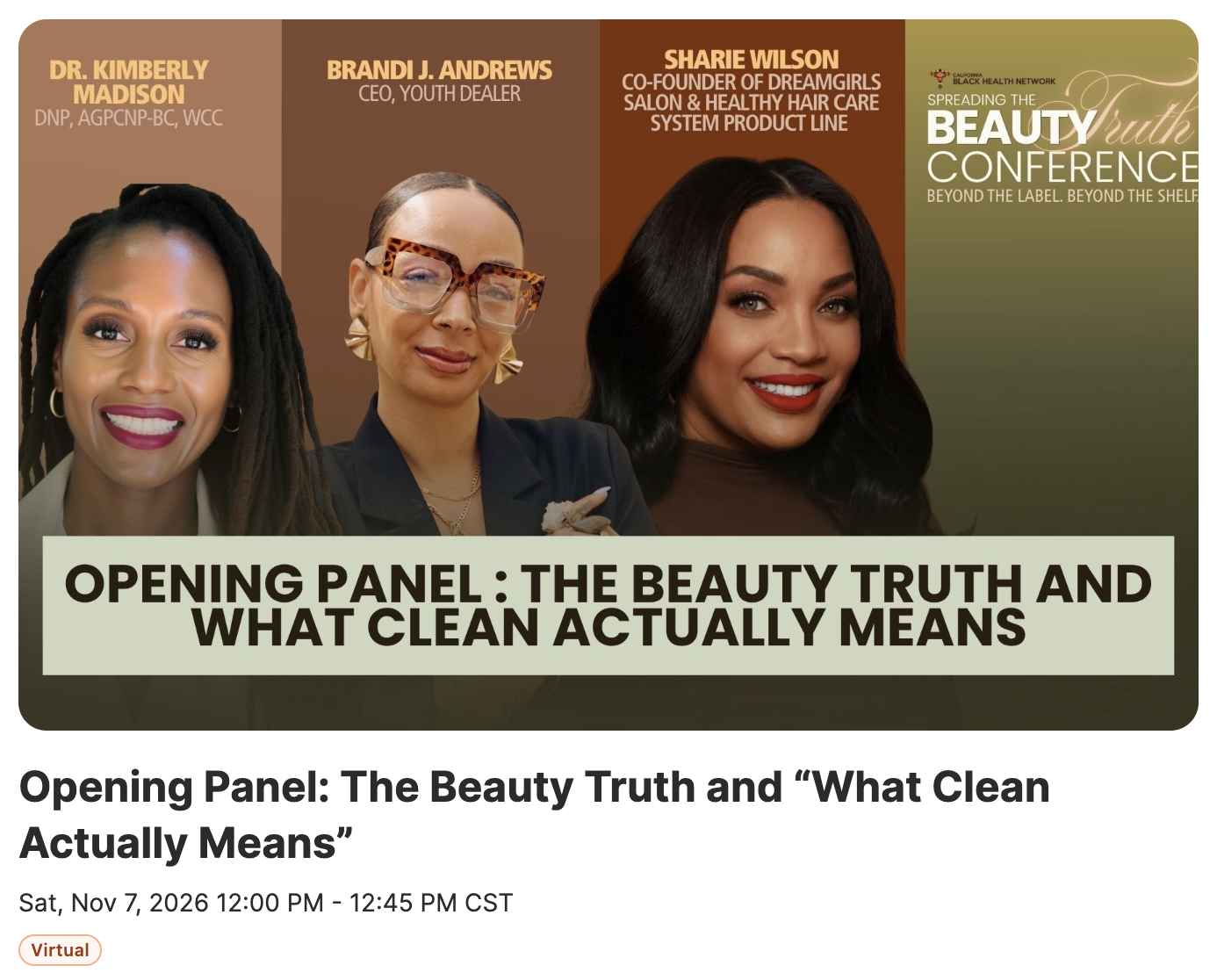
The California Black Health Network's Spreading the Beauty Truth summit is virtual, so you can join from anywhere on Saturday, November 7, 2026, at 10 AM Pacific and 12 PM Central. The Opening Panel, "What Clean Actually Means," includes Dr. Kimberly Madison alongside speakers who are working toward a better beauty industry for all of us. Attendees leave knowing what clean actually means, why the full ingredient list beats the front label, and what to put on the one page they bring to their next appointment. Register before Friday, October 30 for a chance to win $100: REGISTRATION LINK
Every question asked at the counter, in the exam room, and in a summit chat moves the research forward, so that the next product to reach our daughters, our mothers, and our friends is one built with our questions in mind.
About the Author
Dr. Kimberly Madison, DNP, AGPCNP-BC, WCC, is a Board-Certified, Doctorally-prepared Nurse Practitioner, educator, researcher, and author dedicated to advancing dermatology nursing education with an emphasis on skin of color, business acumen, and digital literacy. She is the founder of Mahogany Dermatology Nursing | Education | Research™ and the Alliance of Cosmetic Nurse Practitioners™, the first dermatology nursing organization in the country built at the intersection of clinical excellence, skin of color care, and financial literacy for nurses. A selected participant in the Harvard Business School Foundry Mindset Bootcamp, Dr. Madison continues to sharpen the entrepreneurial infrastructure behind her mission. Through peer-reviewed research, published books, and a growing community of nurse entrepreneurs, Dr. Madison is building the infrastructure that makes this profession sustainable for the people who choose it.
References
Aguh, C., Dina, Y., Talbot, C. C., Jr., & Garza, L. (2018). Fibroproliferative genes are preferentially expressed in central centrifugal cicatricial alopecia. Journal of the American Academy of Dermatology, 79(5), 904–912. https://doi.org/10.1016/j.jaad.2018.05.1257
Araoye, E. F., Thomas, J. A. L., & Aguh, C. U. (2020). Hair regrowth in 2 patients with recalcitrant central centrifugal cicatricial alopecia after use of topical metformin. JAAD Case Reports, 6(2), 106–108. https://doi.org/10.1016/j.jdcr.2019.12.008
Chang, C.-J., O'Brien, K. M., Keil, A. P., Gaston, S. A., Jackson, C. L., Sandler, D. P., & White, A. J. (2022). Use of straighteners and other hair products and incident uterine cancer. Journal of the National Cancer Institute, 114(12), 1636–1645. https://doi.org/10.1093/jnci/djac165
Dermatology Online Journal. (2021). Evaluating the association of central centrifugal cicatricial alopecia (CCCA) and fibroproliferative disorders. Dermatology Online Journal, 27(8). https://doi.org/10.5070/D327854688
Dina, Y., Okoye, G. A., & Aguh, C. (2018). Association of uterine leiomyomas with central centrifugal cicatricial alopecia. JAMA Dermatology, 154(2), 213–214. https://doi.org/10.1001/jamadermatol.2017.5163
Franklin, E. T., Favela, K., Spies, R., Ranger, J. M., & Rudel, R. A. (2026). Identifying chemicals of health concern in hair extensions using suspect screening and nontargeted analysis. Environment & Health. https://doi.org/10.1021/envhealth.5c00549
Gaston, S. A., James-Todd, T., Harmon, Q., Taylor, K. W., Baird, D., & Jackson, C. L. (2020). Chemical/straightening and other hair product usage during childhood, adolescence, and adulthood among African-American women: Potential implications for health. Journal of Exposure Science & Environmental Epidemiology, 30(1), 86–96. https://doi.org/10.1038/s41370-019-0186-6
Helm, J. S., Nishioka, M., Brody, J. G., Rudel, R. A., & Dodson, R. E. (2018). Measurement of endocrine disrupting and asthma-associated chemicals in hair products used by Black women. Environmental Research, 165, 448–458. https://doi.org/10.1016/j.envres.2018.03.030
Johnson, P. I., Favela, K., Jarin, J., Le, A. M., Clark, P. Y., Fu, L., Gillis, A. D., Morga, N., Nguyen, C., & Harley, K. G. (2022). Chemicals of concern in personal care products used by women of color in three communities of California. Journal of Exposure Science & Environmental Epidemiology, 32(6), 864–876. https://doi.org/10.1038/s41370-022-00485-y
Malki, L., Sarig, O., Romano, M.-T., Méchin, M.-C., Peled, A., Pavlovsky, M., Warshauer, E., Samuelov, L., Uwakwe, L., Briskin, V., Mohamad, J., Gat, A., Isakov, O., Rabinowitz, T., Shomron, N., Adir, N., Simon, M., McMichael, A., Dlova, N. C., ... Sprecher, E. (2019). Variant PADI3 in central centrifugal cicatricial alopecia. New England Journal of Medicine, 380(9), 833–841. https://doi.org/10.1056/NEJMoa1816614
Ogunsina, K., O'Brien, K. M., White, A. J., Chang, C.-J., Gaston, S. A., Jackson, C. L., & Sandler, D. P. (2025). Hair straightener use in relation to prevalent and incident fibroids in the Sister Study with a focus on Black women. Environmental Health Perspectives, 133(1), 017004. https://doi.org/10.1289/EHP14493
Schildroth, S., Geller, R. J., Wesselink, A. K., Lovett, S. M., Bethea, T. N., Claus Henn, B., Harmon, Q. E., Taylor, K. W., Calafat, A. M., Wegienka, G., Gaston, S. A., Baird, D. D., & Wise, L. A. (2024). Hair product use and urinary biomarker concentrations of non-persistent endocrine disrupting chemicals among reproductive-aged Black women. Chemosphere, 361, 142442. https://doi.org/10.1016/j.chemosphere.2024.142442
Thomas, C. G. (2023). Carcinogenic materials in synthetic braids: An unrecognized risk of hair products for Black women. The Lancet Regional Health – Americas, 22, 100517. https://doi.org/10.1016/j.lana.2023.100517
Xu, S., et al. (2017). Consumer preferences, product characteristics, and potentially allergenic ingredients in best-selling moisturizers. JAMA Dermatology. https://pmc.ncbi.nlm.nih.gov/articles/PMC5710429