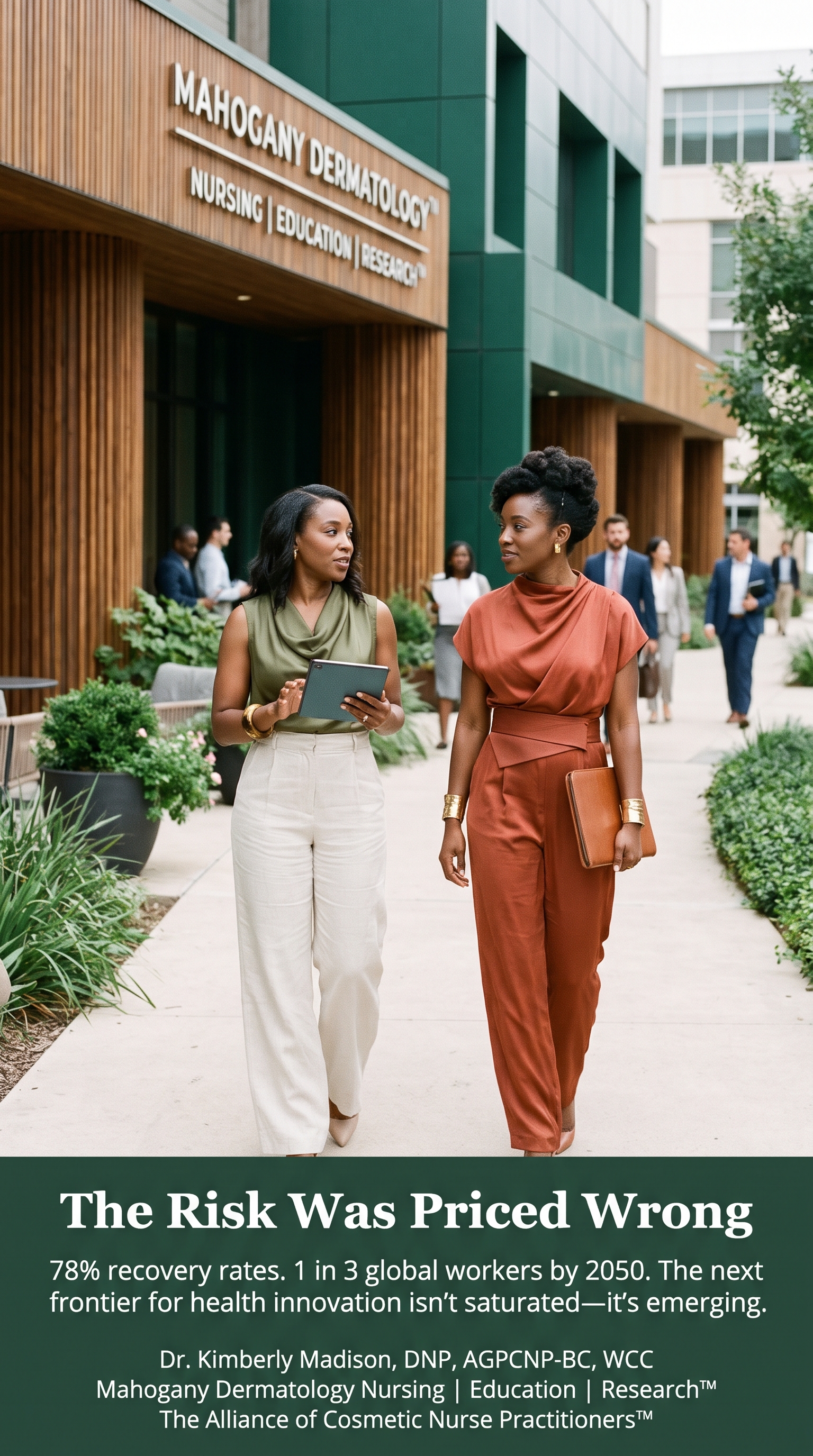
At the Milken Institute, a group of major investors sat down together. The group included a former US ambassador to Kenya, leaders from the World Bank Group and the Africa Finance Corporation, and top private equity and venture capital voices. They explained why Africa is becoming one of the biggest investment stories in the world right now. Here's the moment that stood out most: an economist named Kahir shared that Africa's real default and recovery rates are stronger than most investors think. That means the risk everyone talks about has been priced wrong for years. That's the idea running through everything below. Africa isn't a risky bet trying to prove itself. It's a huge, real opportunity that's been overlooked simply because the story hasn't caught up to the facts yet. When it comes to growing wealth in the US, the market is saturated and expensive. Emerging markets like Africa, especially when it comes to dermatology, aesthetics, and the beauty industry, are ripe for opportunity. While everyone is focused on real estate and private practices, I'm focused on a borderless world for nurses to make money together.
Africa's Investment Story: Why the World's Biggest Investors Are Paying Attention Now
The Real Picture, Bigger and Better Than the Myth
Kahir started by clearing up five common myths about Africa, and the real facts are exciting. Africa is not one country or one economy. It's 55 countries and about 1.5 billion people, one of the most diverse regions on Earth. Yes, there is poverty, about 400 million people across the continent. But Africa also includes high-income places like the Seychelles, fast-growing cities like Lagos, and many countries with peaceful, improving governments. Africa's economy is already worth $3 trillion. By 2050, the population is set to reach 2.5 billion, making it the largest workforce in the world. Last year alone, Africa brought in $100 billion in private investment, on top of $4 trillion in institutional money already sitting on the continent. In many African countries, services now make up 50 to 60% of the whole economy, not raw materials. This is a much bigger and brighter story than most people have heard.
The Youth Advantage
Meg Whitman, the former US Ambassador to Kenya and former CEO of Hewlett Packard and eBay, shared: by 2050, one out of every four people on Earth will live in Africa, and one out of every three working-age people in the whole world will live there too. That's happening in just 25 years. She called it the last and largest emerging market, the last big supply chain opportunity, and the last big consumer market the world hasn't fully discovered yet. The population is young, driven, and full of entrepreneurs looking for real chances to build, especially in manufacturing, health tech, fintech, and farming technology.
The Risk Was Priced Wrong, and Now We Have the Proof
Ethiopus, speaking for the World Bank Group's IFC, shared results from a database tracking more than 40 years of data across emerging markets. Private lending in emerging markets has an average default rate of about 3.5%, similar to solid, B-rated companies in wealthy countries. Recovery rates average around 73%. In sub-Saharan Africa specifically, recovery rates hit 78%, some of the best in the world. In simple terms, the real risk in Africa is lower than people assume, which means the opportunity has been sitting there, undervalued, this whole time. The strongest and steadiest returns show up in banks and financial companies, power grids, digital infrastructure, and transportation and shipping, industries built on real assets and long-term, steady contracts.
Local Money Is Already Building the Future
Somaya, from the Africa Finance Corporation, made an important point. Africans are not waiting around for outside money to build their future. African institutions and African capital are already building it right now. Africa holds over $4 trillion in its own capital, including more than a trillion dollars sitting in pension and insurance funds across the continent. Much of that money currently sits outside Africa or in low-return government bonds. That means there's a real, ready opportunity to put that money to work building infrastructure, industry, and jobs at home, creating even more momentum for growth.
For Medical Professionals
Health tech investment across Africa is already real, and it's already big. One speaker shared that private investors have put billions of dollars into African healthcare over the past 19 years. As mobile phones and AI make it cheaper and faster to reach people, health tech platforms can now serve far more patients at a much lower cost than ever before. That matters directly for anyone building or supporting telehealth, teledermatology, or digital diagnostic tools for African markets. The same kind of digital leapfrogging that brought mobile banking to millions of people is now doing the same thing for healthcare. With such a young population, and huge city growth expected over the next 25 years, there's a real and open opportunity for dermatology and culturally sensitive digital health tools to reach a massive group of people early, well before the rest of the market catches up.
For Entrepreneurs
Africa has very little old infrastructure holding it back, and Whitman pointed to this directly as one of its biggest strengths. Without decades of outdated systems to work around, new technology and AI can be built into a business right from day one. That's exactly how mobile money took off across the continent. M-Pesa, a homegrown Kenyan mobile wallet, now moves more than $300 billion a year and runs through 70% of the entire economies of Kenya and Tanzania, all built on a completely different model than credit cards. That same kind of leapfrog opportunity is wide open right now in fintech, agriculture technology, and health tech, building fresh for a market that skipped the old way of doing things entirely.
For Investors
Where the panel sees the strongest returns. Financial institutions, power and energy infrastructure, transportation, shipping, and telecom all showed the steadiest, strongest returns, according to the World Bank Group's own numbers. Private equity across Africa has also performed well. Fifteen funds returned more than 15%, and another fourteen funds returned more than 10%, often at much lower starting valuations than similar deals in the US or Europe.
Venture capital is picking back up. 2025 marked a real rebound for venture capital across the continent. One standout story: two Egyptian entrepreneurs built an AI voice model called play.ai and sold it to Meta within just 15 months, in an eight-figure deal and one of the best-performing investments in its venture portfolio. Kenya is now the number one destination for venture capital on the whole continent, ahead of Egypt, South Africa, and Nigeria.
Sectors the panel named as top opportunities: fintech, agriculture technology, advanced manufacturing, the creative economy (music, fashion, and sports), tourism (which currently makes up only 5% of international travel worldwide despite Africa's incredible cultural and natural assets), energy, and critical minerals like lithium, cobalt, and copper needed for the world's shift to clean energy.
How to actually get involved. The panel pointed to a few real paths in: co-investing alongside groups like the Africa Finance Corporation, partnering with private equity funds that already specialize in African consumer businesses, and watching for blended finance deals where venture capital, philanthropic money, and government-backed guarantees work together to lower the risk for new investors coming into the market.
A Note on Dermatology, Aesthetics, and Beauty
This panel didn't talk about dermatology or skin of color care directly, but two things they did say point straight at that opportunity. First, the panel shared that billions of dollars have already gone into African healthcare over the past 19 years through private investment. That's not a future promise. That's already happening. Second, Africa has the youngest population in the world, with 70% of people under age 30 and half under age 15. Put those two things together, a fast-growing healthcare investment trend meeting the youngest population on Earth, and you get real, wide-open space for dermatology, skin health, and wellness services built specifically for a culturally diverse market. As mobile phones and digital health tools keep reaching more people faster and cheaper than old-style healthcare systems ever could, this is exactly where the demographic story and the health tech story meet the work already happening in skin of color dermatology and wellness. The timing could not be better.
The pattern across this whole conversation is simple and encouraging. The old story about Africa being too risky, too poor, or too far away has not caught up to the real numbers. The population is growing fast, local money is already moving, and the returns are already beating what most investors expect. This opportunity isn't coming someday. It's already here, and it's coming to the Alliance of Cosmetic Nurse Practitioners.
Three Next Steps
1. Research the health tech investment landscape in Africa. Start looking into who is already funding health tech and telehealth platforms on the continent, private equity firms, development banks like the Africa Finance Corporation, and venture funds active in the space. Knowing the players already writing checks tells you where the door is.
2. Connect with organizations building digital health infrastructure for the culturally diverse market. Reach out to groups already working at this intersection, whether that's telehealth platforms expanding into African markets or dermatology-focused health tech founders building for underserved populations. Ogirima Obey Ezekiel, Registered Nurse and Founder/CEO of AfriDAM AI, and contributing author for Mahogany Dermatology Nursing | Education | Research, is already doing exactly this kind of work, building at the intersection of nursing, AI, and African markets. Community and partnership move faster than building alone.
3. Identify one concrete way to position your own expertise inside this opportunity. Whether that's advising a digital health platform on culturally sensitive protocols, exploring a partnership with a telehealth company entering African markets, or simply tracking this space closely enough to act when the right opportunity appears, decide now what your specific role could be, before the window narrows.
Not financial advice. Do your own research before putting money into any of the above.
About the Author
Dr. Kimberly Madison, DNP, AGPCNP-BC, WCC, is a Board-Certified, Doctorally-prepared Nurse Practitioner, educator, researcher, and author dedicated to advancing dermatology nursing education with an emphasis on skin of color, business acumen, and digital literacy. She is the founder of Mahogany Dermatology Nursing | Education | Research™ and the Alliance of Cosmetic Nurse Practitioners™, the first dermatology nursing organization in the country built at the intersection of clinical excellence, skin of color care, and financial literacy for nurses. A selected participant in the Harvard Business School Foundry Mindset Bootcamp, Dr. Madison continues to sharpen the entrepreneurial infrastructure behind her mission. Through peer-reviewed research, published books, and a growing community of nurse entrepreneurs, Dr. Madison is building the infrastructure that makes this profession sustainable for the people who choose it.