The Textbook Problem: What Dermatology Education Misses About Global Skin and Culture
Many students struggle to find a DNP mentor when they want to complete a dermatology-focused doctoral project. Imagine my delight when I came across Dr. Kaylyn Bourne's Belmont University DNP project. In its second cycle, 14 graduate nursing students went from a 64% average to 94% on a diagnostic accuracy test across skin tones, and this article shows you how. You will see the first attempt that did not work and what fixed it, teaching points you can use with students and colleagues this week, and three DNP project ideas built on her findings. You will also get a five-step plan to bring the module into your own program or practice, research questions worth a dissertation, and business opportunities for those of us who build. Whether you teach, precept, practice, or lead, you will know where to start.
A Note Before We Get Started
I have achieved a lot of accomplishments in life, and when I reflect on my career, I am grateful that I lived long enough to check all the boxes to the point that everything now and moving forward is a bonus. However, nothing brings me more joy and humility than to receive the respect and trust of my peers, especially in nursing. Dr. Bourne's work represents one of the key messages I wrote about when I first started the Mahogany Dermatology blog: you do not have to be a person of color to talk about the lack of diversity in dermatology nursing education, nor are you required to talk about it if you are a person of color. But one thing is true: there are not enough people of color to treat all the people of color in the world, so it's up to all of us to address this problem. As long as this remains a problem, we are not delivering the standard of care. Our DNP training teaches us that it is not enough to simply address this problem one-on-one; we must address it systematically as a profession, globally. Dr. Bourne's doctoral research gives us the blueprint that all of us can execute. I can't thank her enough for gracing us with her permission to share her research, her picture, and her contact information. By the way, she said, if you are interested in implementing the Quality Improvement Project: Multi-Program Replication of the Skin Tone Inclusive Dermatology Module discussed below, she'd love to hear from you!
Introduction
For years, we've published ideas for dermatology DNP projects. I've personally had the privilege of advising two of you to the completion of successful DNP projects: one utilizing AI to increase diagnostic confidence, and one increasing access to care for early detection of alopecia through a referral system connecting hair care professionals and dermatology providers. So you can imagine our delight to share a DNP project with you in this article, and the best part is the focus on dermatology nursing education that reflects the global, culturally diverse patients we serve.
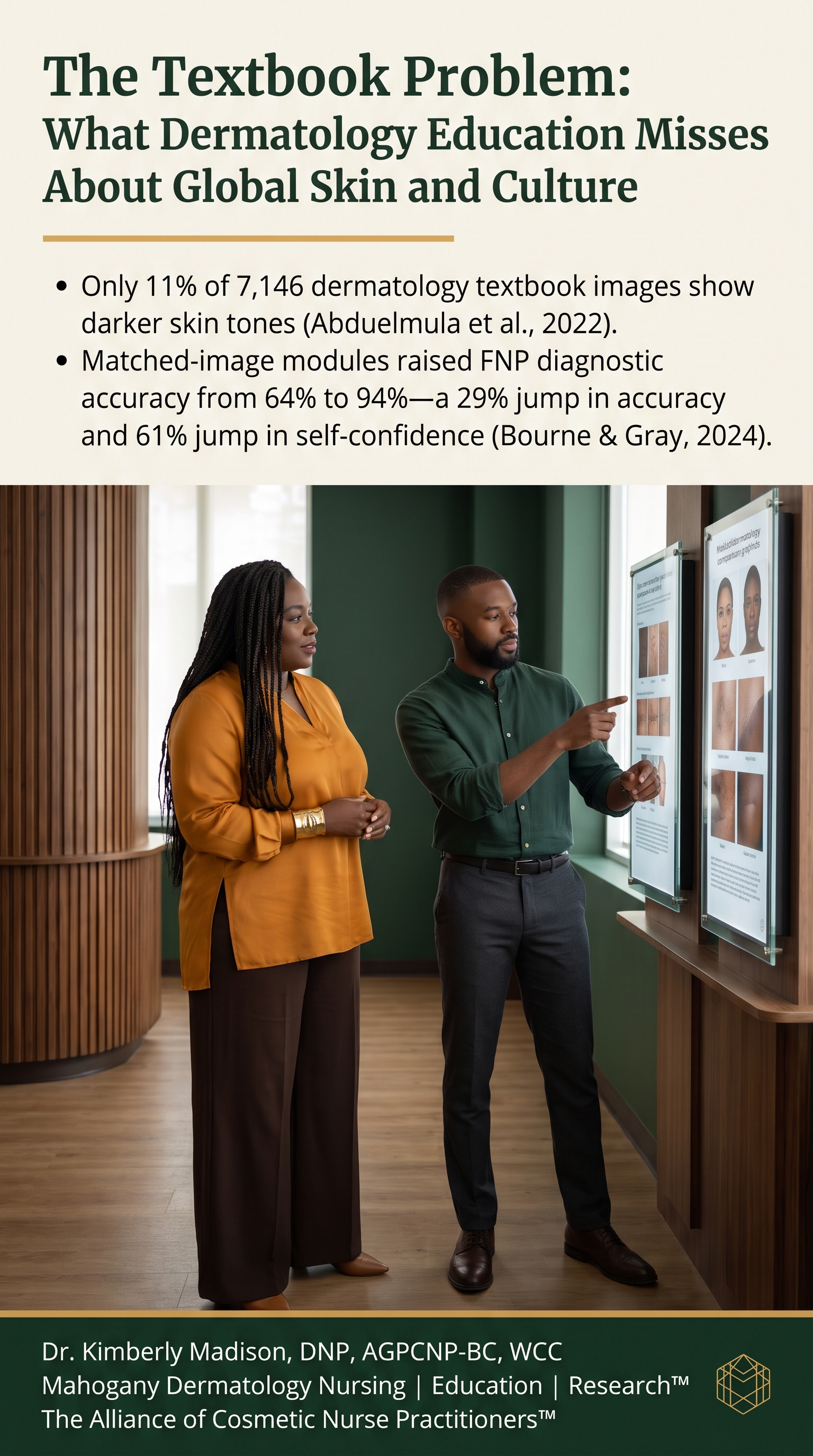
Kaylyn Bourne, DNP, completed her scholarly project at Belmont University in 2024, advised by Laura Gray, PhD, RN. Her project answers a question our field has circled for years without enough data to settle it. Does adding skin tone inclusive dermatology content to a graduate nursing curriculum actually change what students can diagnose and how confident they feel doing it? Bourne ran two Plan-Do-Study-Act cycles with 24 FNP students, and the second cycle produced a 29% jump in diagnostic accuracy and a 61% jump in self-confidence, with statistical significance behind both numbers.
This is the kind of evidence our field needs. Proof that representation, built into a curriculum correctly, changes what a clinician can see.
A note of recognition before we go further. Dr. Bourne's project is one of the references behind this article, and we are grateful for the care she put into it and for making her work available to our field. Congratulations to her, to her advisor Dr. Gray, and to her project team, Dr. Jeannie Giese and Dr. David Phillippi, on research that gives dermatology nursing education something concrete to build on. Throughout this article, we point back to her full project, which we encourage you to read.
Background and Significance
Patients from culturally and ethnically diverse backgrounds face measurably worse dermatologic outcomes than their light-skinned counterparts, and the disparity starts long before a patient sits in an exam room. Bourne's introduction cites research (Bell et al., 2020) showing that patients with diverse skin tones are less likely to receive newer and standard therapies for acne, atopic dermatitis, and psoriasis. It also cites American Cancer Society figures (2023) putting five-year melanoma survival at 94% for white patients and 70% for Black patients, a difference that points to when and how accurately the disease gets caught.
Most skin disease is managed in primary care rather than in dermatology offices, and Bourne cites a 2022 analysis (Grada et al.) estimating that non-dermatologists, NPs among them, handle 52.9% of common skin conditions there. We are, in practice, a frontline dermatology workforce. And yet skin tone inclusive dermatology content is not standardized in undergraduate or graduate nursing programs. Certification exam blueprints from AANPCB and ANCC don't define dermatologic competencies at all, which means a program can produce a fully licensed FNP without any requirement to have learned the material.
The textbooks compound the problem. The imagery problem is well documented. A 2022 audit by Abduelmula and colleagues found that only 11% of 7,146 images across 26 dermatology textbooks showed darker skin tones. Wilson and colleagues (2021) reviewed 52 dermatology journals and found darker skin tone representation between 2.04% and 16.8%. Okoro and colleagues (2021) reported that only 16% of preclinical dermatology photographs at three American medical schools depicted darker skin tones. The pattern holds in nursing education too. Lyon and colleagues (2026) found that only 18.4% of the teaching images in one institution's NP core courses showed darker skin tones, and a 2025 analysis of five pediatric nurse practitioner textbooks by Huntsman and colleagues reported that only 28% of 2,112 teaching images did. Dermatologic proficiency depends on learned recognition, on training your eye to catch the hallmark signs of a condition. When the images a student studies from skew almost entirely toward one presentation of disease, the eye trained on those images will miss what it was not shown.
Bourne's project set out to test whether a deliberately designed intervention could close that training deficit inside an existing course, not as a separate elective, but folded into the advanced health assessment class every FNP student already takes. She built a two-part module using VisualDx, a clinical decision support system with over 45,000 images, 29% of which represent darker skin tones. In the first PDSA cycle, 10 students completed a self-paced dermatology terminology lesson called LearnDerm, followed by a curated 90-minute lecture covering 13 conditions commonly seen in primary care, each one shown and described in both light skin and darker skin tones.
That first cycle produced mixed results. Self-confidence in recognizing skin disease in darker skin tones improved, but diagnostic accuracy actually dropped by 7%, and the change wasn't statistically significant. Bourne and her team didn't treat that as a failure. They treated it as data. Student feedback pointed to specific design flaws: too much content delivered at once, a pretest and posttest that used different images, and quiz questions that lacked clinical context like age, gender, and symptom history.
The second cycle fixed every one of those problems. LearnDerm was replaced with a shorter companion PowerPoint. The single 90-minute lecture became three focused 20-minute sessions on rashes, infections, and skin malignancies. Pretest and posttest images were matched, and clinical context was added to every quiz question. Fourteen new students went through the revised module, and the results were the kind you build a curriculum change around. Diagnostic accuracy rose from a 64% average pretest score to 94% on the posttest, a statistically significant result confirmed with a Wilcoxon signed rank test. Trimmed mean self-confidence rose 61%. Students reached proficiency, defined as 80% correctness or higher, in nine of thirteen skin conditions tested, including melanoma.
One limitation: Bourne's own project names the possibility that participants discussed pretest and posttest answers with one another, which she notes could affect the fidelity of the results.
The qualitative responses point to why the second cycle worked. Seven of the 14 students in the second cycle named photos of different skin tones as the single most meaningful part of the module. One participant's response, reported in Bourne's project, points to a curriculum problem rather than a confidence problem: before the module, the student did not think they would have noticed many conditions on darker skin, because those conditions rarely appear in the textbooks and slides they had used. Bourne's project shows what it takes to address that. The effect is not limited to one program or one country. A 2024 study of 158 medical students at the University of Hamburg found that a skin type diversity seminar improved their self-assessed knowledge of how skin disease presents on darker skin and their confidence in diagnosing it.
Implications for Nurse Practitioners Who Work in Global Dermatology, Aesthetics, and Beauty
Our patients arrive with skin concerns that cross cultures, regions, and skin tones, whether we practice in global dermatology, aesthetics, or beauty, and our training may not have prepared us for that full range. Bourne's project gives us a template, not a theory. A short, well-designed, image-matched intervention, delivered inside a course students already take, produced a measurable and statistically significant change. Here is what that template means in each setting.
In global dermatology, presentation changes with skin tone and with setting, so training has to be built with local clinicians and local images. Bourne's design (matched images, short modules, and clinical context in every question) travels well because none of it depends on one country or one curriculum. The World Health Organization's front-line training guide, described in the business section below, exists because skin changes are often first seen by workers who are not specialists.
In aesthetics, you look at skin every day, which places us to notice what a patient has not. Bourne's teaching points apply to the skin we assess before we treat it: a concerning lesion can be more pigmented and less red on darker skin, and lingering post-inflammatory pigment can stand out more than the active condition. Recognizing those differences before treatment starts is part of the care we already promise.
In beauty, people trust stylists, makeup artists, and the hair, skin, and nail products they use every day, often before they ever see a clinician. Those same touchpoints are where a skin, scalp, or nail change can first be noticed. A DNP student I advised developed a referral system for early alopecia detection that connects hair care professionals with dermatology providers, and it is one model for that bridge, and Bourne's matched-image approach shows how to train the bridge to recognize what deserves a referral. For NPs who advise beauty brands, it also opens a practical question: whether shampoos, skincare, and makeup were developed and tested across skin tones.
That has direct implications for how we build our own continuing education, how we train new associates in our practices, and how we evaluate the CE we're already paying for. If a CE module doesn't show a condition across multiple skin tones side by side, it isn't preparing us for the patients actually sitting in our chairs. The same applies to how we onboard new hires. A short, well-designed dermatology refresher built the way Bourne built hers, with matched pretest and posttest imagery and real clinical context attached to every question, is something any practice owner can replicate internally. A 2024 project at the Christie NHS Foundation Trust in Manchester shows the same principle in wound care: after short ward-based training sessions, the share of clinicians who knew that dark skin tones carry a higher risk of severe pressure ulcers rose from 46% to 71% (Pramod et al.).
For those of us serving as clinical preceptors or adjunct faculty, this project is also a mandate to look hard at what our own students are being shown. If your program's dermatology content leans heavily on light skin presentations, you now have published, statistically significant evidence that the fix is achievable inside a single semester, without overhauling the whole curriculum. Educators in the UK describe the same obstacles. In a 2024 survey (Clemett et al.), most understood why all skin tones matter in teaching, but they cited a shortage of good-quality photographs and limited confidence in teaching them.
Key Teaching Points We Can Use With Students and Colleagues
Bourne's supplemental study guide, written for her students, describes how these conditions present in light skin and in darker skin tones. The points below are our own condensed summary of that idea, so please see her project for the full guide.
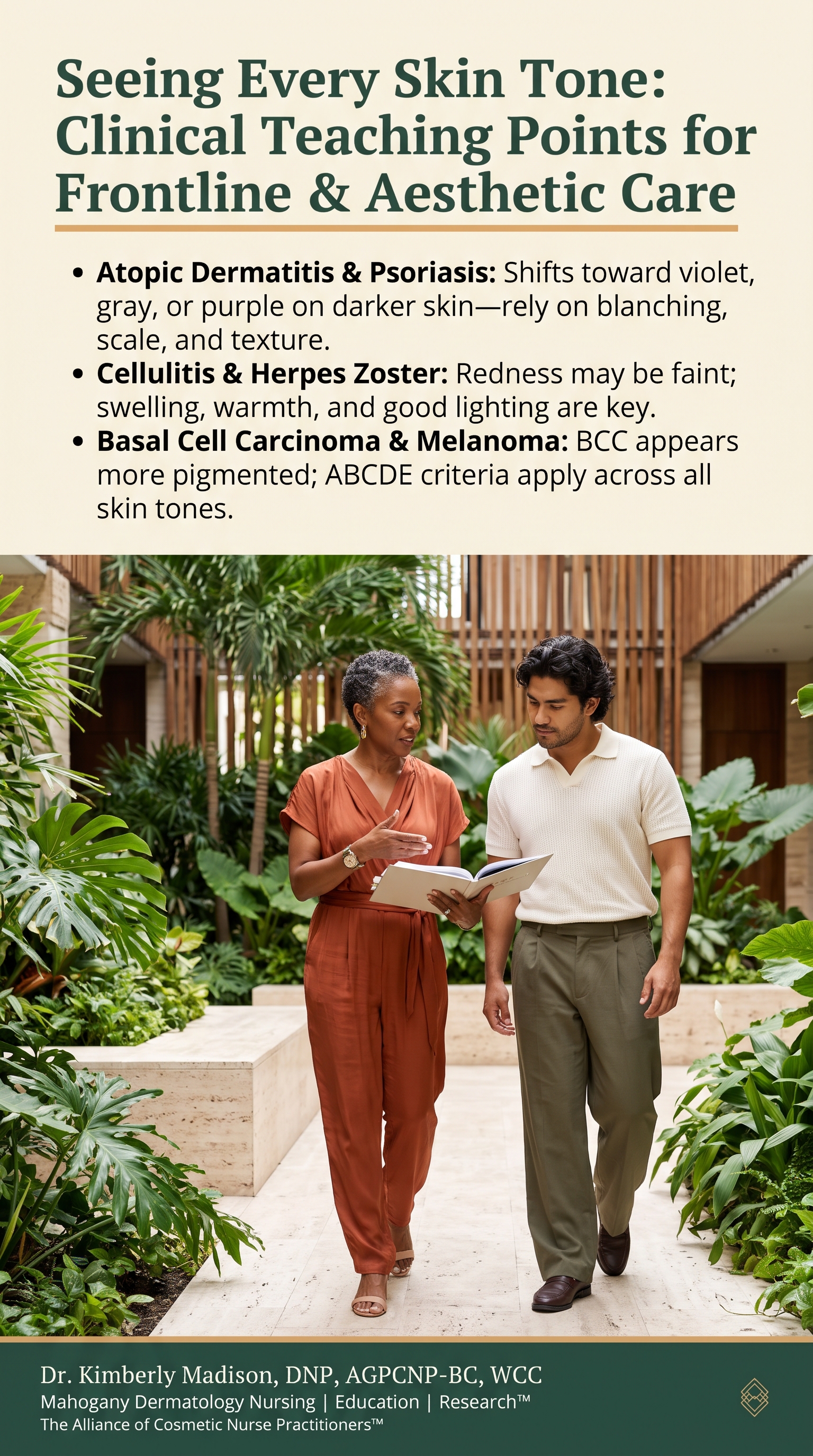
Atopic dermatitis often reads as bright redness on lighter skin, while on darker skin the color can shift toward violet, gray, or brown. A gentle press that blanches the skin helps confirm active inflammation.
Psoriasis may look purple rather than pink on darker skin, so scale and texture are often the steadier clues.
Cellulitis can look subtle on darker skin. When redness is faint, swelling and warmth may be the clearer signs, and good lighting helps.
With tinea corporis, the color of the scale varies with skin tone, and lingering post-inflammatory pigment can stand out more than the active lesion.
Basal cell carcinoma in Black and Hispanic patients tends to be more pigmented and less red, and it can be mistaken for a mole instead of the classic pearly bump.
Melanoma's ABCDE criteria (asymmetry, border, color, diameter, evolution) apply across every skin tone. The lesion's color pattern is what shifts, not the rule for evaluating it.
Herpes zoster may show faint or purplish color instead of the strong redness most teaching images depict, and pigment changes afterward can last longer on darker skin.
DNP Project Ideas Inspired by This Research
Quality Improvement Project: Multi-Program Replication of the Skin Tone Inclusive Dermatology Module
Aim: Test whether Bourne's refined second-cycle module produces similar gains in diagnostic accuracy and self-confidence across FNP, PMHNP, and AGNP programs, not just one FNP concentration at one university. Description: Partner with two or three schools of nursing to run the identical intervention (matched pretest and posttest images, context-rich quiz questions, three 20-minute condition-specific lectures) and compare results across program types. This directly answers a limitation Bourne named in her own project, that findings from one FNP program at one university may not generalize to other specialties.
Evidence-Based Practice Project: Institutionalizing Skin Tone Inclusive Content as a Graduation Requirement
Aim: Move skin tone inclusive dermatology content from an optional module to a required, competency-assessed component of a DNP or MSN curriculum. Description: Use Bourne's findings, along with the certification blueprint deficits at AANPCB and ANCC, to build the case to a curriculum committee. Develop the assessment rubric, secure faculty buy-in, and pilot the requirement for one cohort with pre- and post-implementation data tracked against national board pass rates in dermatology-adjacent content. See our list of Essential Dermatology Textbooks for Skin of Color - our most downloaded resource in the Mahogany Dermatology Nursing Bookstores since publication (updated regularly).
Policy-Focused Initiative: Defining Dermatologic Competencies in National NP Certification Blueprints Aim: Advocate for AANPCB and ANCC to explicitly name dermatologic domains, including diverse skin tone competencies, in their certification exam blueprints. Description: Compile the published evidence, Bourne's project among it, into a policy brief demonstrating that certification bodies currently have no requirement driving programs to teach this content at all. Present the brief to certifying body committees, state NP associations, or schools of nursing accreditation bodies, with the explicit ask of adding measurable dermatologic and diverse skin tone competencies to the exam blueprint.
Step-by-Step Guide: From Idea to Implementation
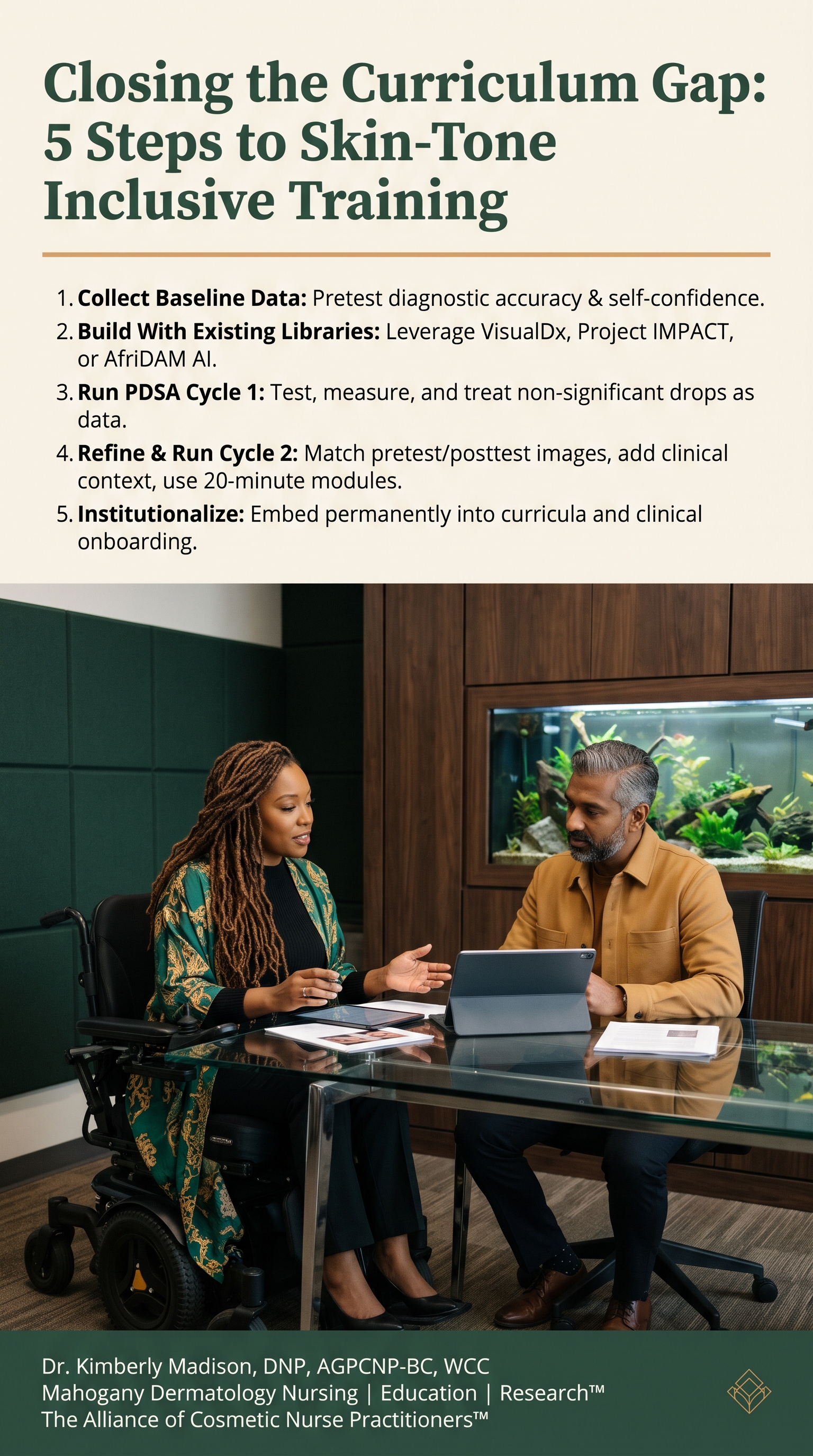
Step 1: Baseline Data Collection. Before building anything, measure what your students or staff currently know. Administer a short diagnostic accuracy quiz and a validated or project-specific self-confidence survey, the same way Bourne did in her ENGAGE phase, so you have a real pretest to compare against.
Step 2: Build the Module Using an Existing Resource. You don't need to build an image library from nothing. As a VisualDx app champion, I can tell you that the company works with medical schools to give students access and has recently begun working with nursing schools. Members of the Dermatology Nurses' Association, the Society of Dermatology Nurse Practitioners, and DNPs of Color can also get a discount through their membership. Project IMPACT provides open-access imagery of diverse skin tones specifically for education. Curate 10 to 15 conditions relevant to your setting and pair every condition with matched imagery of light skin and darker skin tones. You can also reach out to the team at AfriDAM AI, where the founder, Obey Ezekiel, RN, is also a contributing author for the Mahogany Dermatology blog has collected over 50,000 images.
Step 3: Run a First PDSA Cycle and Study the Results. Deliver the module, administer the posttest and post-survey, and analyze what worked and what didn't, the way Bourne's team did after cycle one. A drop in accuracy or a non-significant result isn't a failed project. It's the data that tells you what to fix.
Step 4: Refine and Run a Second Cycle. Apply what you learned. Match your pretest and posttest images, add clinical context to every quiz question, and break long lecture content into shorter, focused segments. This single set of changes is what took Bourne's results from non-significant to a statistically confirmed 29% accuracy gain.
Step 5: Disseminate and Institutionalize. Present your findings to your program's curriculum committee or your practice's clinical leadership, and push for the intervention to become a standing part of the course, onboarding process, and/or policy, not a one-time pilot. Bourne's key stakeholder chose to permanently incorporate the module into the course curriculum, which is the outcome every QI project should be aiming for.
PhD Nurse Research Opportunities
Bourne's project surfaces several unanswered questions worth a dissertation:
No validated instrument exists to measure NP student self-confidence in dermatologic diagnosis. Bourne had to build her own survey tool, with no established psychometrics behind it. A PhD candidate could design and validate a standardized self-confidence instrument for use across nursing dermatology education research.
Demographic moderators are unstudied. Bourne's project collected no demographic data, so we don't know whether a student's own racial or ethnic background affects diagnostic performance or confidence in cases across skin tones. A dissertation could explore this directly, with appropriate IRB protections in place.
Durability of the gains is unknown. Bourne's project measured immediate posttest results only. A longitudinal study tracking diagnostic accuracy and confidence six or twelve months after the intervention would tell us whether a short module produces lasting change or a temporary bump.
Potential dissertation topics:
Development and Validation of a Dermatologic Self-Efficacy Scale for Graduate Nursing Students
Sustained Diagnostic Accuracy in Diverse Skin Tones Following Brief Educational Intervention: A Longitudinal Study
Entrepreneurial Opportunities and Business Strategies
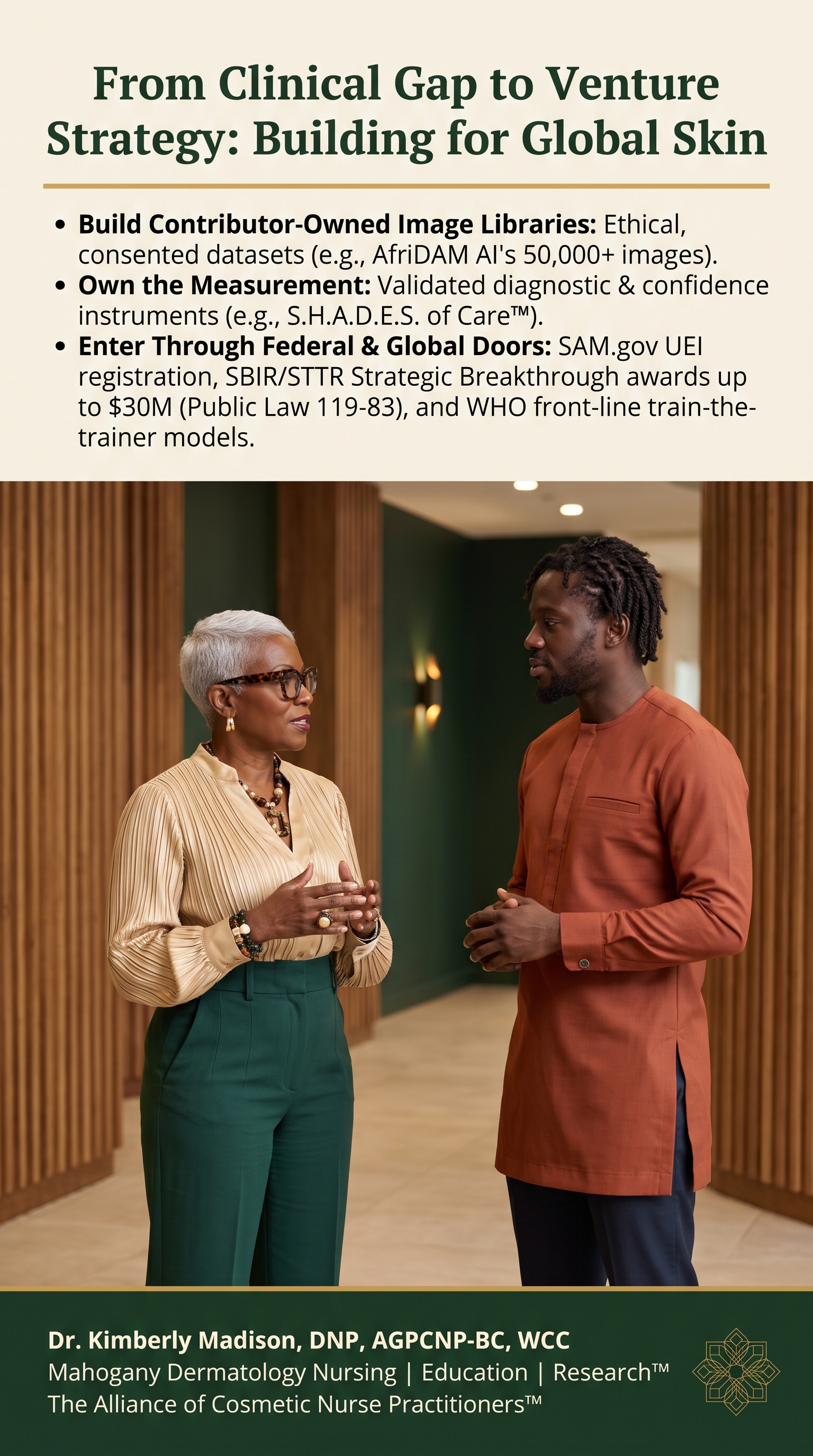
Build the image library, not another course. Bourne's gains came from matched, labeled images shown across skin tones, supplied by a single clinical decision support system, VisualDx. Her paper also names a dearth of accessible images as a barrier to anyone trying to replicate her work. A library of consented, clinician-verified images, collected with local partners in Africa, South Asia, Latin America, and the Middle East, is hard to copy and fills that need. A founder building AI for African markets starts with three questions: who owns the images, who benefits when they are licensed, and how contributors share in the revenue. A contributor-owned library licensed to schools, publishers, and AI developers answers all three, provided patient consent and privacy protections are written in from the first image. Obey Ezekiel, RN, founder of AfriDAM AI in Lagos, Nigeria, is building in this direction. After leaving his job to build full time, he has collected more than 50,000 images for an AI Skin Scanner designed for darker skin tones, and the app connects users to dermatologists.
Own the measurement. Bourne built her own confidence survey because no validated instrument exists for nursing or NP students, and her paper states that the survey has no psychometrics. A validated assessment of diagnostic accuracy and confidence across skin tones answers the question every buyer eventually asks: how do we know it worked? Programs need it for evidence, certifying bodies need it because Bourne reports their exam blueprints do not define dermatologic competencies, and employers need it for onboarding. Every administration adds to a benchmark that no single program can build alone. I had the pleasure of meeting a clinician-founder already working this way, Valerie Crenshaw, RN, WCC, at the HEAL conference. Valerie founded Healing Hands Wound Care after nearly two decades in wound care. The company began by connecting skilled wound care professionals with healthcare facilities and grew into an education, consulting, and clinical solutions company. Her S.H.A.D.E.S. of Care™ framework is designed to improve the identification and assessment of pressure injuries in darker skin tones, and it shows the path: start with a service, learn where the clinical problem sits, and build a framework others can use. Frameworks like hers become standards when they are measured, which is where a validated assessment comes in. Look out for her assessment in your EHR next to the Braden Scale soon!
Enter through the government door. Government is a buyer of training and technology, and the first steps cost little. Registering in SAM.gov and getting a Unique Entity ID is free, registrations renew every 365 days, and APEX Accelerators give small businesses free help completing the paperwork. From there, the work is watching federal notices for training needs, teaming with an established prime contractor to build past performance, and aiming at agencies that employ or fund large numbers of NPs, such as the Veterans Health Administration and HRSA-funded community health centers.
Research dollars are open as well. Public Law 119-83 extended SBIR and STTR through September 30, 2031, and created Strategic Breakthrough awards of up to $30 million for small businesses that already hold a Phase II award and can show matching funds from new private or government sources. Whether a validated assessment or an AI-assisted training tool fits depends on each agency's published topics. The law also adds screening of foreign ownership, investment, and business ties with entities in countries of concern, so any partnership abroad needs documented ownership and a lawyer's review before work begins.
Take it global through front-line workers. A global health nurse starts where care actually happens, with front-line workers who are not dermatology specialists. The World Health Organization published a training guide in 2018 for exactly those workers, covering conditions such as scabies, leprosy, and yaws, and it notes that pathways often involve referral to a specialist service. The opening for a venture is to adapt Bourne's design, with matched images, short modules, and clinical context in every question, build it with local clinicians, deliver it by phone, and connect each learner to a referral pathway. A train-the-trainer model, where each trained nurse teaches the next cohort, can keep the cost per learner low and keep the content in local hands.
Each of these ventures gets stronger when the people whose skin appears in the images are partners and owners, not only subjects. Our nursing superpower is knowing what the learner and the patient need at the point of care, and the opportunity is to leverage that into companies that return value to the clinicians, founders, and communities who helped build them.
Closing Statement
Bourne's project didn't just prove that skin tone inclusive dermatology education works. It proved exactly how to build it, cycle by cycle, so the next program doesn't have to guess. Every student who learns to recognize melanoma on darker skin, every nurse practitioner in global dermatology, aesthetics, or beauty who recognizes cellulitis or a pigmented lesion on darker skin because they were shown what it looks like, carries that training into a patient's life. That's the real measure of this work, not the accuracy score on a posttest, but the diagnosis that gets made the first time correctly, for the patient who has waited far too long for that to be the norm.
About the Author
Dr. Kimberly Madison, DNP, AGPCNP-BC, WCC is a Board-Certified, Doctorally-prepared Nurse Practitioner, educator, researcher, and author dedicated to advancing dermatology nursing education with an emphasis on skin of color, business acumen, and digital literacy. She is the founder of Mahogany Dermatology Nursing | Education | Research™ and the Alliance of Cosmetic Nurse Practitioners™, the first dermatology nursing organization in the country built at the intersection of clinical excellence, skin of color care, and financial literacy for nurses. A selected participant in the Harvard Business School Foundry Mindset Bootcamp (2026), Dr. Madison continues to sharpen the entrepreneurial infrastructure behind her mission. Through peer-reviewed research, published books, and a growing community of nurse entrepreneurs, Dr. Madison is building the infrastructure that makes this profession sustainable for the people who choose it.
Bourne, K., & Gray, L. (2024). The effect of skin tone inclusive dermatology education on diagnostic accuracy and self-confidence in graduate nursing students. DNP Scholarly Projects, 88. Belmont University.
Effects of a skin type diversity seminar on undergraduate medical students' self-assessed competence in managing skin diseases in patients with skin of colour. (2024). BMC Medical Education, 24(1), 848.
World Health Organization. (2018). Recognizing neglected tropical diseases through changes on the skin: A training guide for front-line health workers.