My Most Useful Advice If You're Trying to Get Into Dermatology, Aesthetics, and Beauty in 2027
On any given day, I can expect to see a DM, an email, or a social media post about how to get into dermatology or aesthetics, or see another new skin care or hair care product enter or leave the market. Particularly, when it comes to nurses and nurse practitioners trying to enter dermatology or aesthetics, the general conversation is around not being able to get hired. They're not the only ones facing challenges in the industry; even those with over 20 years of experience still need help with navigating private equity buyouts, limited volunteer support, and little to no budgets. You've heard me say it before: there are so many problems to solve in dermatology, aesthetics, and beauty. You don’t need someone to hire you. You don’t need to have a million-dollar budget. You don’t need to wait for 20 years of experience. You don’t need anyone to put you on their advisory board. Do it yourself. Productize your intellectual property and monetize it. In this article, I break down my most useful advice if you're trying to enter, scale, or create your own lane in dermatology, aesthetics, or beauty in 2027. You will get the most from this read if you start with a mindset of abundance and realize that opportunities are created, not hoped for, and ANYONE can create them. You don't need any validation; you just need to 1) get started, 2) stay consistent and persistent, and 3) find a community to do it with. Even Emma Grede attested to this. She said no one would hire her and pay her what she knew she was worth, so she hired herself, and we can all see where that landed her. Let's dream out loud together!
Getting into dermatology, aesthetics, and beauty does not start with a job posting. The path starts with relationships, visible contribution, and an understanding of how a business makes money. Here is the advice that holds up whether we are new graduates, nurses exploring a new specialty, or clinicians ready for a change.
Warm introductions open doors that applications do not
The old-fashioned way still works. We ask for warm introductions, or we show up in person with a resume and CV, a memorable outfit, a memorable gift (coffee, a basket of healthy snacks, or a homemade treat, something economical), and a goal. The goal might be a conversation with the office manager, the best time to talk to the hiring manager, a look at openings, or mentorship. If we completed clinical rotations at a dermatology clinic, that clinic is the first place to ask, either for an opportunity there or for a referral.
Mentorship deserves its own line on the list. Even if you don't land a derm or aesthetic job right away, a mentor can provide ongoing education, continue to expand your network, and make warm introductions (and you never know when an opportunity might present itself with a long-established, trusting relationship). The same applies to working for someone who owns their own non-derm clinic, where we can negotiate to get all the derm-related visits and where that mentorship I just mentioned matters most.
Active membership turns an organization into visibility
Membership in an organization only helps when we are active members, the kind who help move the mission of the organization forward. Otherwise, we have to ask whether the dues are worth it. Active members also gain more visibility, which is the real return on the money. You will always learn more by being active and getting to go behind the curtain, than you will by passively sitting in the seats waiting to be entertained.
A clear vision for our life shows us which lane to build
Before choosing a path, ask what vision we have for our life. Then ask how dermatology or medicine gets us there. We all went to school for specialized training that leads to a JOB, yet most of us want freedom, financial security, and the option to live the life we want, instead of a JOB that dictates the life we live.
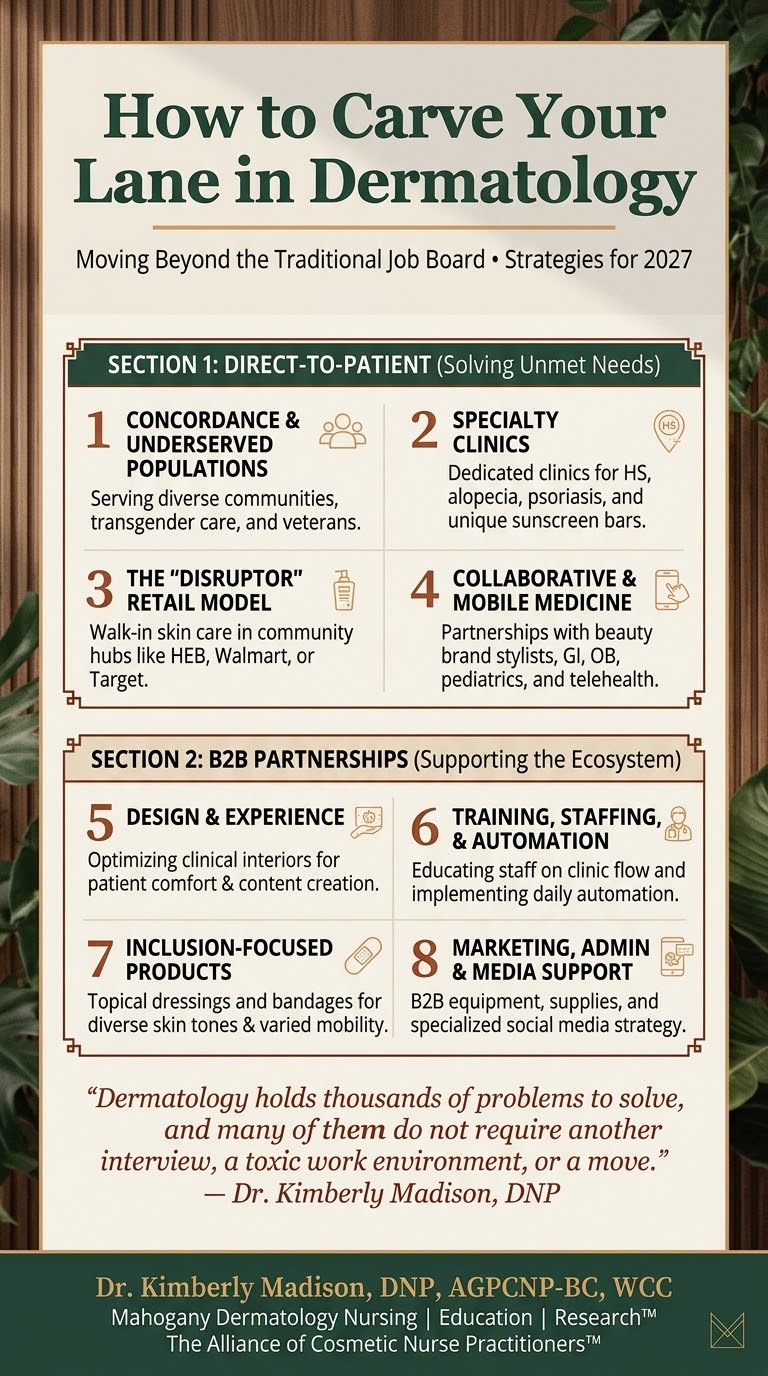
One of the most recommended books on this path is Key Person of Influence, because we can create a lane for ourselves in whatever specialty we choose, as long as we believe it and show up every day. Dermatology, aesthetics, and beauty hold thousands of problems to solve, and many of them do not require an interview, another certification, risk to our license, a toxic work environment, a move to another state, or a significant pay cut. Example: Caleb Runyon, founder of the Closer Look Project. Got his first job directly after graduating NP school in a dermatology clinic. Worked there for one year and then left for greener pastures. Since then, he started working at a free clinic offering dermatology services on his own terms and working on his Spanish, which took him on a life-changing trip outside of the United States to Colombia. He didn't ask for permission. He leveraged what he already knew and already had. Now, the Closer Look Project pays him way more than he ever would have made working for someone else. He's also a published author, national speaker, has a CPG brand, and works with the Society of Dermatology Nurse Practitioners. You can talk to him directly when he shares his secrets for getting on national news as a regular contributor when he speaks at the Alliance of Cosmetic Nurse Practitioners' first virtual summit, Jan 15-17, 2027. He'll be giving away all his secrets.
2027 Industry Strategy Explorer
How to Carve Your Lane in Dermatology, Aesthetics & Beauty
Select a track and click any pathway below to explore 2027 launch mechanics and real-world case models.
The skin is everywhere in medicine, and our training already qualifies us to start
The skin shows up across every speciality in medicine and across our communities throughout the entire lifespan. The baseline education and training we have already earned is enough to help someone establish a treatment plan. Continued education, mentorship, and connections then expand how many patients we can help reach appropriate care.
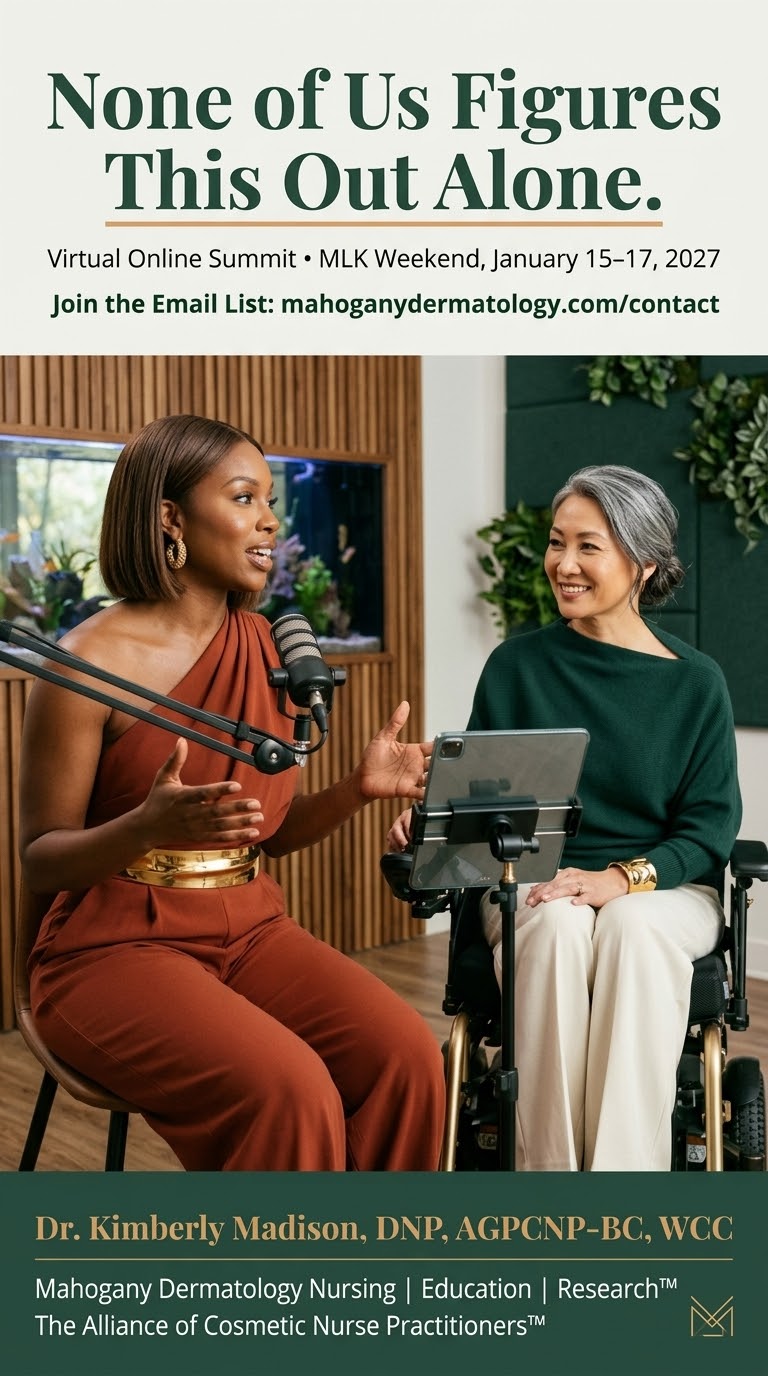
Examples of carving a lane are easy to find. The Mahogany Dermatology blog (see the Beyond the Needle series) and our YouTube playlists show countless ones, and Caleb Runyon and Go Skin Check show others. None of us figures this out alone. When we all come to the table, we can solve almost anything. The DMV Dermatology NP + PA group was built for exactly that; those who live in the DMV (DC, Maryland, and Virginia) can join as long as you meet the criteria and answer the questions. Alternatively, you can join our sister group, DERM NPs + PAs of Atlanta, which we started in collaboration with Ali Belvin who is weeks away from graduating NP school at Emory University!
Learning the business earns the high end of every negotiation
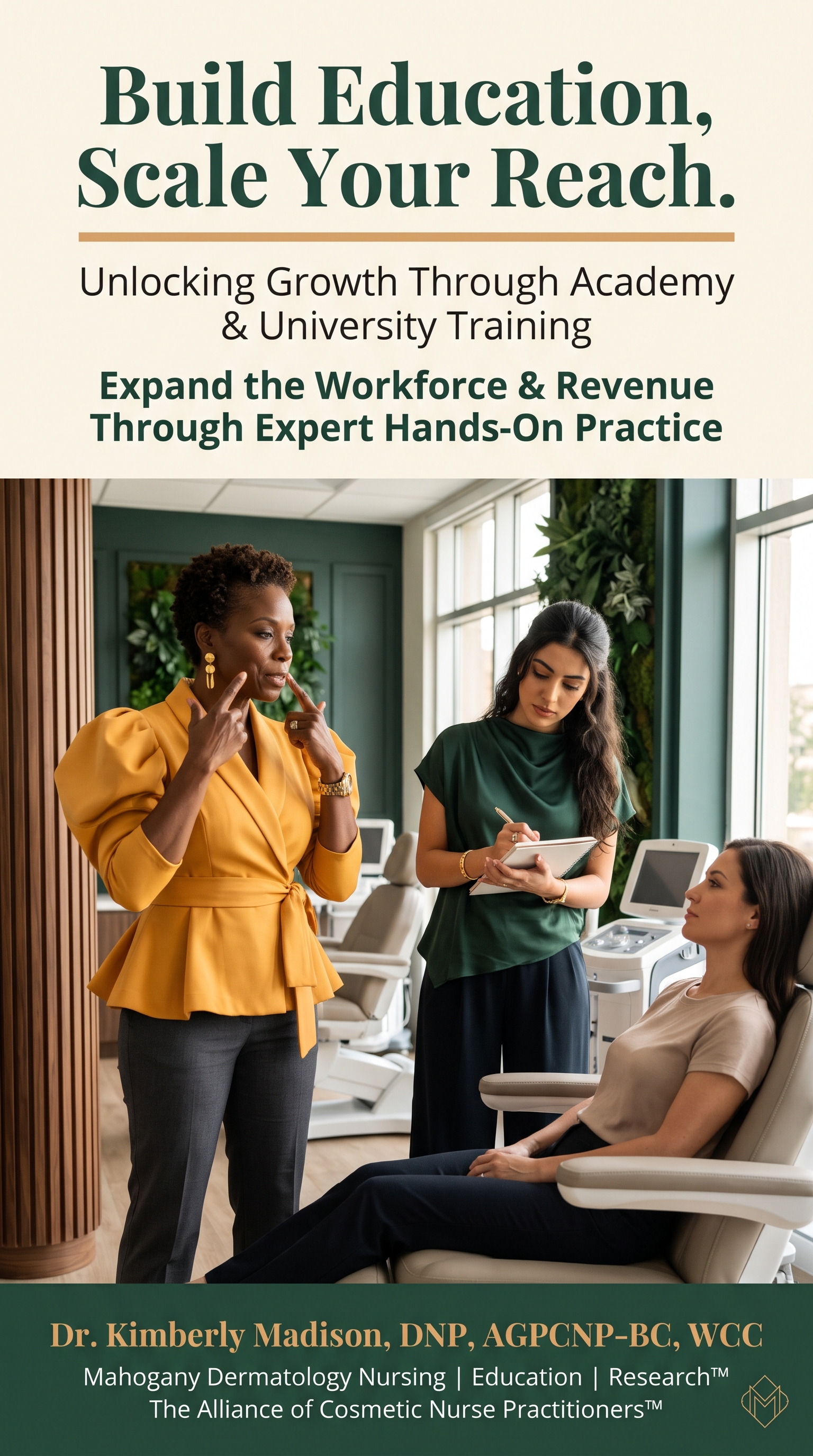
The most overlooked way to practice in dermatology is to learn the business. The two biggest problems for dermatology entrepreneurs are funding and staffing. Showing that we are pursuing ongoing education and mentorship, and that we can help a practice owner grow the business, earns the high end of a negotiation. Growth here means customer acquisition, marketing, sales, social media, employee retention, automation, and productivity.
When you show up as a new graduate or new to derm, you show up as more WORK. Owners already have more work than can be done in a day. So the question becomes how we add value and how we relieve them of added WORK. People agree to almost anything when we save them time and money. Even dermatologists need help. They can only answer so many questions per visit. One popular dermatologist made a social media post telling patients she could only answer 1 of their 18 questions per visit. So where does that leave the patient? They still need help. This is where you can come in at any point of the care continiuum: primary (screening, risk assessment, prevention, education), secondary (initiating or evaluating treatment), or tertiary (subspecialized or rare cases). Tertriary or post-diagnosis phase could also include patients who don't want conventional treatment, who've accepted their condition (like baldness without intervention), or paliative care who still have concerns, questions, and needs.
Understanding private equity in dermatology is time well spent
Private equity firms are investment firms that buy ownership stakes in businesses, and they are active in dermatology (and in medicine in general). We do ourselves a great service by taking the time to learn how they operate before we choose where to work. In addition to the private equity model, we see more and more dermatologists wanting more flexible schedules, needing assistance with managing collaborative agreements, and wanting to work remotely. How can you help? You don't need to go to medical school to figure out everything. Look to some companies that have been successful. Follow the money, then follow the model. Think outside the box and look outside of medicine for inspiration. During our 8-week Accelerator following the Alliance of Cosmetic Nurse Practitioner Summit, we'll be creating this exact opportunity so you don't have to figure it out alone.
Every route into a specialty is hard, so we get to pick our hard
If all of this seems like a lot of work, so is entering a new specialty. The question is what kind of work we are up for, because it is all hard. We pick our hard. Once we find something we love, it hits different, and the patients and the next generation of clinicians get a colleague who chose this work on purpose.
How to Think About Getting Into the Industry
When I first got interested in dermatology, I went straight to the literature to see where we've come from, where we are, and the opportunities moving forward. I fell in love with so many parts of dermatology that really don't get enough attention.
This specialty in particular is largely driven by pharma. Think back to school: what it requires to graduate, pass boards, and maintain your licensure is heavily focused on prescriptions. So pharma really drives the industry in a lot of ways. The big companies remain the big companies because they can afford to walk into your clinic and treat your whole staff to lunch. They can afford to sponsor your conference and dictate the agenda. That's why every conference, every webinar, every special fellowship and internship is sponsored by the same companies, and they talk about the same diagnoses: acne, psoriasis, vitiligo, alopecia areata, and atopic dermatitis. They'll sprinkle in a little bit of skin of color, with the main focus being on how difficult it is to assess diverse skin tones, and then that's it. No solutions are offered, and there's no overview of the latest research or of other diagnoses. They would have you thinking that those are the only diseases you're going to see walk into your clinic.
When I hear people say such-and-such brand is the best brand, that's not really true. The truth is there are thousands of products on the shelf, and until you test every single one, you can't say which is the best. What you can say is which is the most popular, the one that can afford to get in front of my face all the time. I learned this when I worked for the United States Biology Olympiad. They described the students who participated in that program as the best in biology in the country, but that wasn't true. What was more accurate was to say that of the schools that participated in the program, and of the students who could afford to apply, these are the top students of that percentage. That's when I learned how to really listen and be more critical.
Here are some ways to think about how to get into the industry.
1. Population. If you're part of a group outside of the American majority, you have a competitive advantage. The literature shows it, and there's a term for it: when the person who sees you is the same race or ethnicity, it's called concordance. Think of a Nigerian focus, which is a huge population, or Asian communities, or the Hispanic and Latinx community (Spanish isn't even considered a foreign language anymore). The transgender community is very underserved and a large population, and so are veterans. Women's health could go here as well.
2. The type of medicine you deliver. Conventional versus integrative.
3. Where you meet the patient in the continuum. Primary care, screening, and education. People who require active treatment. Follow-up treatment. Palliative care, for people who can't or don't want treatment, which is one we really don't spend a lot of time on. You can also meet patients through telehealth, mobile dermatology, space medicine, or schools.
4. Specialty clinics. A transgender clinic could be a specialty clinic. So could acne, alopecia, or atopic dermatitis, and so could an HS (hidradenitis suppurativa) clinic, a psoriasis clinic, a hair loss clinic, a menopause clinic, or a clinic for hyperpigmentation and pigmentary disorders. Even within medical, surgical, and aesthetic dermatology, you can put any of the examples above into those categories. In aesthetics, you could do only topicals, and have fun with that one. You could do only laser, and have fun with that one. Become a master at your craft. Another specialty clinic is a sunscreen bar, a whole store dedicated to sunscreen. Sunscreen, sunscreen, sunscreen is all you sell. You would be known as the ultimate KOL (key opinion leader) when it comes to sunscreen. Everybody would want you to test their sunscreen, and they would send it to you. You would get the first sunscreens, all the filters, all the brands from all across the world. That's a fun one. You could expand later and scale into products like UPF clothing, hats, and glasses.
5. Socioeconomics. There are two types of service models. You could do the luxury model, which everyone seems to think is the only option, or you could do the Walmart model (I love this one so much. I'll be talking more about this soon). I can talk to you all day long about Walmart's valuation, how long they've been around, and how successful they've been at meeting the needs of most people.
6. Partnerships with other specialties. GI, OB, allergy, immunology, wound care, pediatrics, mental health specialists, and fertility clinics. Partner with chiropractors, surgical centers, hair stylists, and nail techs. If you're in wounds, partner with dialysis centers. If you're in integrative derm, partner with natural health food stores, supplement shops, and fitness appareal. Not just randomly with a table setup. Literally, build your clinic inside their real estate
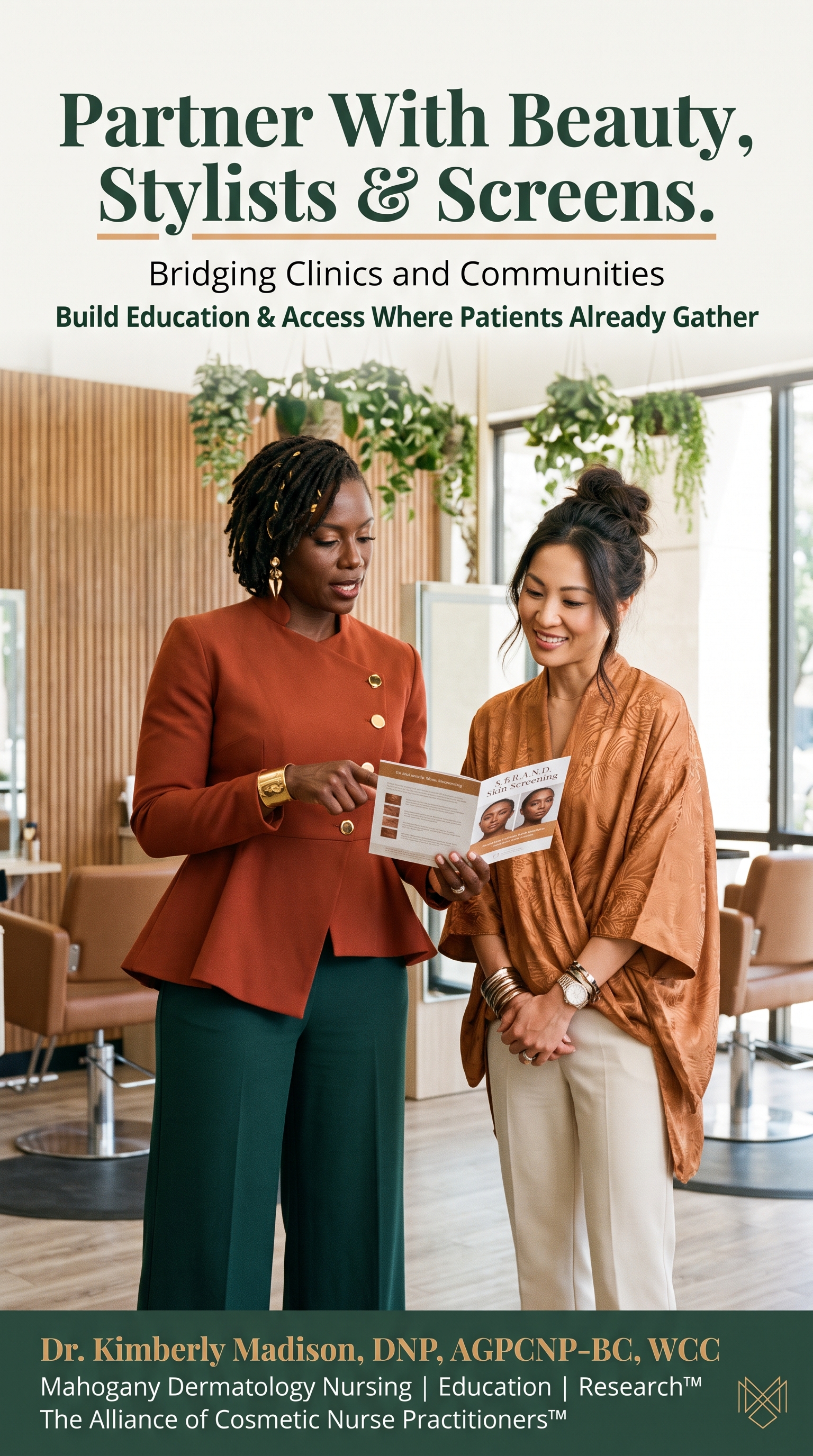
7. Partnerships with beauty brands and screening programs. Right now we see dermatology providers partnering with hairstylists, like the S.T.R.A.N.D Network, which promotes working with an in-house dermatology provider and hairstylist. This is underutilized amongst NPs. Alternatively, consider being the dermatology provider and partnering with a beauty brand instead. I was listening to the founder of The Lip Bar talk about her story, and I would love to see a partnership like that. You can also work with someone like Go Skin Check, and with the Closer Look Project, and build education and community partnerships that get people their annual skin screenings.
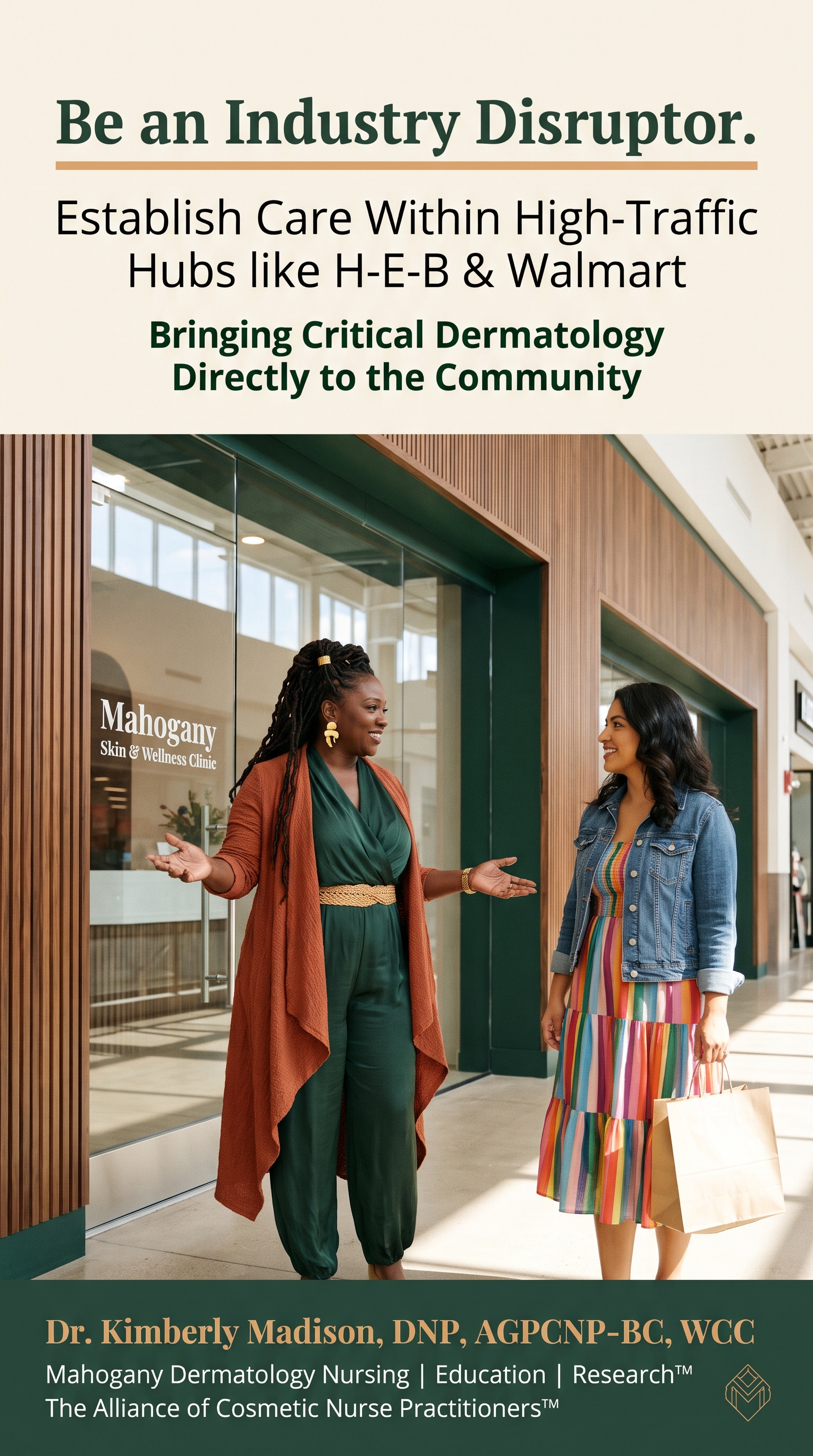
8. Be an industry disruptor. Really think about changing the mold. If there's a middleman, take them out. If there's no middleman, add them in. If there's tech, ask what the luxury feature of having something in person would be. If everything's in person, ask what it would look like with a little bit of tech added. Look at brands you absolutely love and study their models, especially the ones that went against the grain. Figs did a little something different. So did Warby Parker. The Lip Bar is unique too, because nobody was doing those bright colors before. Sometimes when something pops up, you think, oh my God, why didn't I think of that? Someone could start small and then scale. Here in Texas, we have a 100s of H-E-Bs. What if inside each one you had a little clinic, the way we have eye doctors with glasses? Start in H-E-B and you get a local contract, which is a lot of contracts, since H-EB is all over the place in Texas. Then you expand statewide, and eventually nationwide. Everyone always thinks luxury, but Walmart isn't luxury, and it has millions and millions of clients. The same goes for a Walmart: you could pitch them and set up a skin clinic right there inside the store, kind of like how CVS has the MinuteClinic. You could put a derm clinic inside any Kroger, H-E-B, Walmart, or Target. So many options. Even if you only got Texas, that's enough. You have to be realistic about your goal. You don't need hundreds of thousands of clients. You really need to do the math and figure out how hard you need to work and for how long.
You can apply these strategies anywhere, including dermatology.
Now for some B2B ideas, which means businesses that serve dermatology and aesthetic offices.
Interior design. Design dermatology and aesthetic offices to elevate the patient experience, the value of the practice, and its marketing. Offices can also earn additional revenue by renting space to others for content creation.
Staffing and training. Staffing and hiring, plus educating staff on clinical practice, marketing, and sales.
Automation. Be the human in the loop who helps optimize daily operations and productivity so everyone gets paid more.
Supplies and equipment. Gloves, chairs, bathroom supplies, aroma therapy, doors, decorations, lighting, smart clinics, OSHA safety, sustainability and environmentally friendly features, clothing and merchandise, shoes, waiting room experience, set up activations inside the clinic, and allow vendors (in and outside the industry) to set up shop.
Topical dressings. Dressings suited for diverse skin tones, children, people with limited mobility, and autistic patients.
Specialty in-house clinics.
Social media. Allow content creators, brand deals, and researchers to record in-house.
A research and development arm. Partner with researchers, academic centers, tech hubs, pharma, entrepreneurs, and establish your own IRB.
And these are only the beginning. We have only scratched the surface of B2B models. It's really limitless. Depending on the resource you look at, dermatology has three to four thousand different diagnoses, so your options are unlimited. It is not a saturated, competitive market unless you keep looking where everybody else is looking.
Real businesses to study, starting with nurse-led brands
Each idea above already has a working version somewhere. Studying how these founders funded, launched, and sold shows us which pieces to copy and which to change. The first group is nurse-led. The groups after it come from aesthetics, dermatology, beauty, retail, and supply chain, and each entry points back to a number in the list above. Figures marked self-reported come from the founder's own interviews.
Nurse-led brands
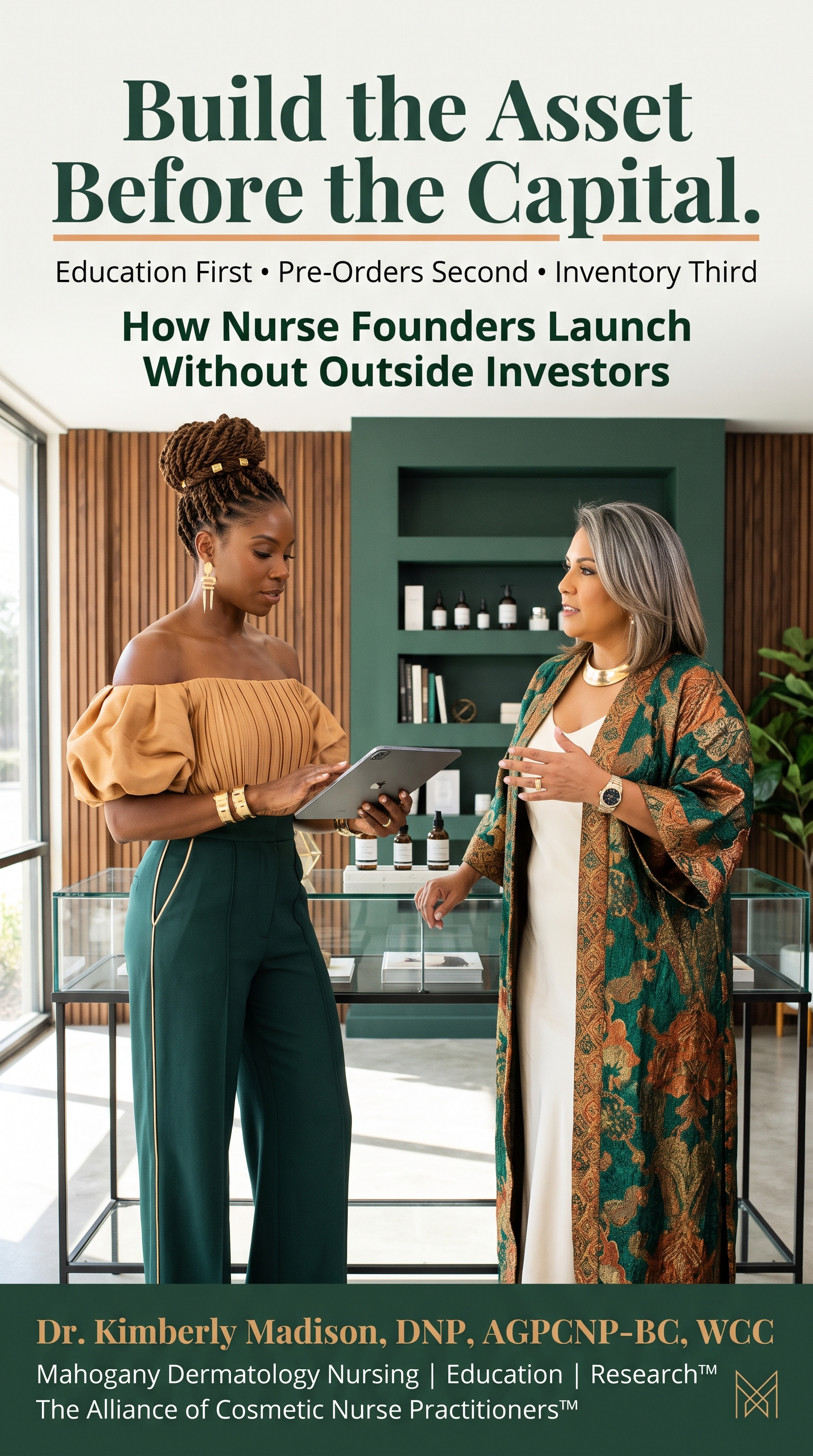
Barefaced, founded by Jordan Harper, NP. Harper began posting skin education on Instagram in 2015 to grow her patient base, and the brand launched in 2020, about five years of audience-building later. She told Entrepreneur that she paid for the first production order with five 0% interest credit cards, pre-sold thousands of units to her Instagram community, and reached profitability in the first year (self-reported). She also scrapped a 50,000-unit run of eye patches that missed specifications, a loss of about $100,000. The order matters: education first, pre-orders second, inventory third.
Skin Pharm, founded by Maegan Griffin, NP. Griffin opened a cosmetic dermatology clinic in Nashville in 2017 and added an in-house skincare line in 2018. According to the company, every appointment is led by a nurse practitioner or physician assistant. Belmont University reported in April 2024 that the company had taken a $15 million investment from Prelude Growth Partners, a female-founded growth equity firm, to expand nationwide. The clinic sells its own products and outside capital pays for new locations, which makes it a useful companion to the private equity section above.
Bask & Lather, founded by Shaina Rainford, NP. Rainford's mother made a scalp stimulator and hair elixir after Rainford's younger sister lost her hair to a severe scalp condition, and Rainford used the same formula after losing hair following COVID-19 in 2020. Essence reports that the brand was founded by the end of 2020, took no investors or loans, and reinvested its earliest profits (self-reported). The brand also claims the top spot among Black-owned hair-growth oils on Amazon. A hair loss specialty, a family formula, and funding from its own sales add up to the hair loss clinic idea in number 4.
The Route, founded by Nancy Pellegrino, NP, and Courtney Baber. Pellegrino runs NP Aesthetics Inc. in Newport Beach, and Baber is a beauty industry veteran. Together they launched a professional, medical-grade skincare line on September 22, 2019, and built a Nurse Powered Network that gives nurses 30 percent off purchases. Pairing a clinician with a beauty operator is number 7 in practice.
LexRx, founded by Alexa Nicholls Costa, NP, and Alexandra Rogers, NP. The Boston practice was founded in 2015 and, according to a co-founder's bio, has grown to five Massachusetts locations while staying founder-owned and cash-flow positive, with no outside investment or business loans (self-reported). Its co-founders say a nurse practitioner always performs the injections, and every provider is trained in the LexRx method so results stay consistent. LexRx has also added a fertility service. Its training branch, Inject With Lex, partnered with Boston College's Connell School of Nursing in 2023, and the American Med Spa Association reported in January 2026 that UNC-Chapel Hill joined Boston College and Columbia University in offering the courses. Nurse practitioner owners grew the practice by adding services and university-partnered education without outside capital (numbers 4 and 6).
Niche populations and specialty services. A Brooklyn nurse practitioner launched FuzzClinic, a skincare collection for melanated skin tones and for people managing PCOS and unwanted hair, and says it is the only brand addressing PCOS in skincare (the founder's claim). Keisha Wagner-Gaymon, NP, founded Peach Fuzz Skin Studio to give Black women and women of color a safer space for laser hair removal. Amy Birkenstamm, RN, runs the Glo Derma medical spa and GLO Academy, which adds in-person and virtual training and business mentoring. Together they show a population and a specialty (numbers 1 and 4) and an education arm that earns its own revenue.
Aesthetics
Lashelle Ullie, LE. Ullie is a licensed esthetician in Los Angeles who owns the Lashelle Effect Atelier in Beverly Hills and focuses on men's skin health. He pioneered the Gentlemen's Skin Engineering Technique for conditions unique to men, and he lectured on oncology skin care for men of color at the 2023 Integrative Esthetician Track. He crosses a population (men) with a service (oncology skin care), which is numbers 1 and 4 together.
Models from dermatology, beauty, retail, and supply chain
Curology. Dr. David Lortscher founded what the company calls the first online dermatology practice in 2013. Patients upload photos of their skin to a team of dermatology specialists, and a personalized prescription formula ships to the home on a subscription. A recurring subscription replaces repeat office visits, which is number 3, telehealth, run as a business.
S.T.R.A.N.D. Network. Dr. Chesahna Kindred, an associate professor of dermatology at Howard University, co-founded Stylists Training, Researching, And Networking with Dermatologists. Per its own about page, the network is an education platform that connects hair care professionals with dermatologists, co-led by hair loss specialist Susan Peterkin. It runs stylist hair loss workshops and free community events, and reports educating 246 stylists across eight states as of October 2025 (self-reported). The same bridge can be built from the nursing side (number 7).
FIGS. Heather Hasson and Trina Spear launched the scrubs company in 2013. Fortune reports that the idea came from a 2012 coffee with a nurse practitioner friend. According to Shopify, more than 90% of the business now sells direct to consumer through the company's website. Selling directly to a profession skips the middleman, which is number 8.
Warby Parker. Harvard Business School student analyses describe a vertically integrated model, meaning the company controls design, manufacturing, and sales, with a Home Try-On program that mails five frames to the customer with free shipping both ways. Home Try-On adds a tech convenience to a product people still want to try in person (number 8).
The Lip Bar, founded by Melissa Butler. Butler started making vegan lipstick in her kitchen in 2012. Beauty Independent reports a $2 million seed round in 2018 and a launch into Target. Glossy reports that the brand has sold through Walmart since 2021 and expanded into 3,300 CVS locations in September 2023. Building a direct-to-consumer following first, then meeting that customer at big-box retailers, is the Walmart model in number 5.
MinuteClinic. CVS describes MinuteClinic as a medical clinic inside select CVS Pharmacy stores, led by nurse practitioners and physician associates, with oversight from board-certified collaborating physicians. The company has expanded from walk-in sick care toward primary care. A practitioner-led clinic placed where customers already shop is number 8.
CB Sourcing and CB Legacy Global Logistics & Storage, led by Chevy. The company's sourcing page lists its services as finding suppliers, protecting the client's brand, managing factory visits, and shipping products internationally. Its Instagram says the team has been on the ground in China for 17 years and runs China tours for buyers (self-reported). A separate post describes a seven-year journey that began with helping clients ship and store products and grew into a Black-owned logistics company operating in China. Chevy also teaches the business itself. A recent post describes a Becoming a Sourcing Agent course with a regular price of $2,499 and an offer to release it for $499 if 1,000 people show interest, and it says students do not need to live in China (self-reported). Chevy built sourcing, shipping, and storage services on the ground in a market where Chinese firms are the main players, tests demand before launching an education arm, and fits the supplies and equipment idea in the B2B list above. Anyone interested in the course or the China tours should contact her directly through her website or her Instagram, @cbsourcing.
Several founders above built an audience or a partner first and the inventory or the location second. Harper pre-sold to her followers before the product existed, Butler built a direct-to-consumer following before big-box shelves, and Pellegrino paired clinical credibility with a beauty executive. Harper and Rodriguez leveraged a nursing superpower, teaching before selling, into a competitive advantage. Studying these models lets the next generation of nurse founders skip mistakes the founders before us already paid for.
What these founders owned before the first sale, and a 90-day test for ours
Compare the founders on one question: what did each own before the first sale? Harper owned an audience built over about five years. Rainford owned a family formula, and Rodriguez owned a following she had taught about hair care ingredients as a registered nurse. Griffin owned a clinic experience, with a product line added a year later. Costa and Rogers owned a clinical method, since a nurse practitioner always performs the injections. In each case the asset came before the capital. Harper paid for her first production run with credit cards, Rainford reports no investors, and LexRx reports no outside investment (all self-reported), while Skin Pharm took growth equity seven years after opening. That pattern is our inference from these examples, not a finding from a study.
Now judge the models on four criteria: the money needed to start, the time to first revenue, the dependence on a partner or platform, and the fit with a clinician who still has a job. Audience-first models such as Barefaced and Mielle need the least money to start but the most time, and Harper posted for about five years before launching. Clinic-first models such as Skin Pharm and LexRx can earn from patient visits right away, but the founder's own hours cap them until others are hired and trained. Partnership models such as The Route share the work and also share the control. Our judgment, with moderate confidence, is that a nurse practitioner who still holds a job lowers risk by pairing a small education or audience step with one niche service, because that pairing tests demand before money is spent. Two limits apply. These are success stories chosen because they worked, so we see only one failure, Harper's scrapped eye patch run, and nearly every figure is self-reported. A funder offering capital without control would shift the weight toward the partnership model.
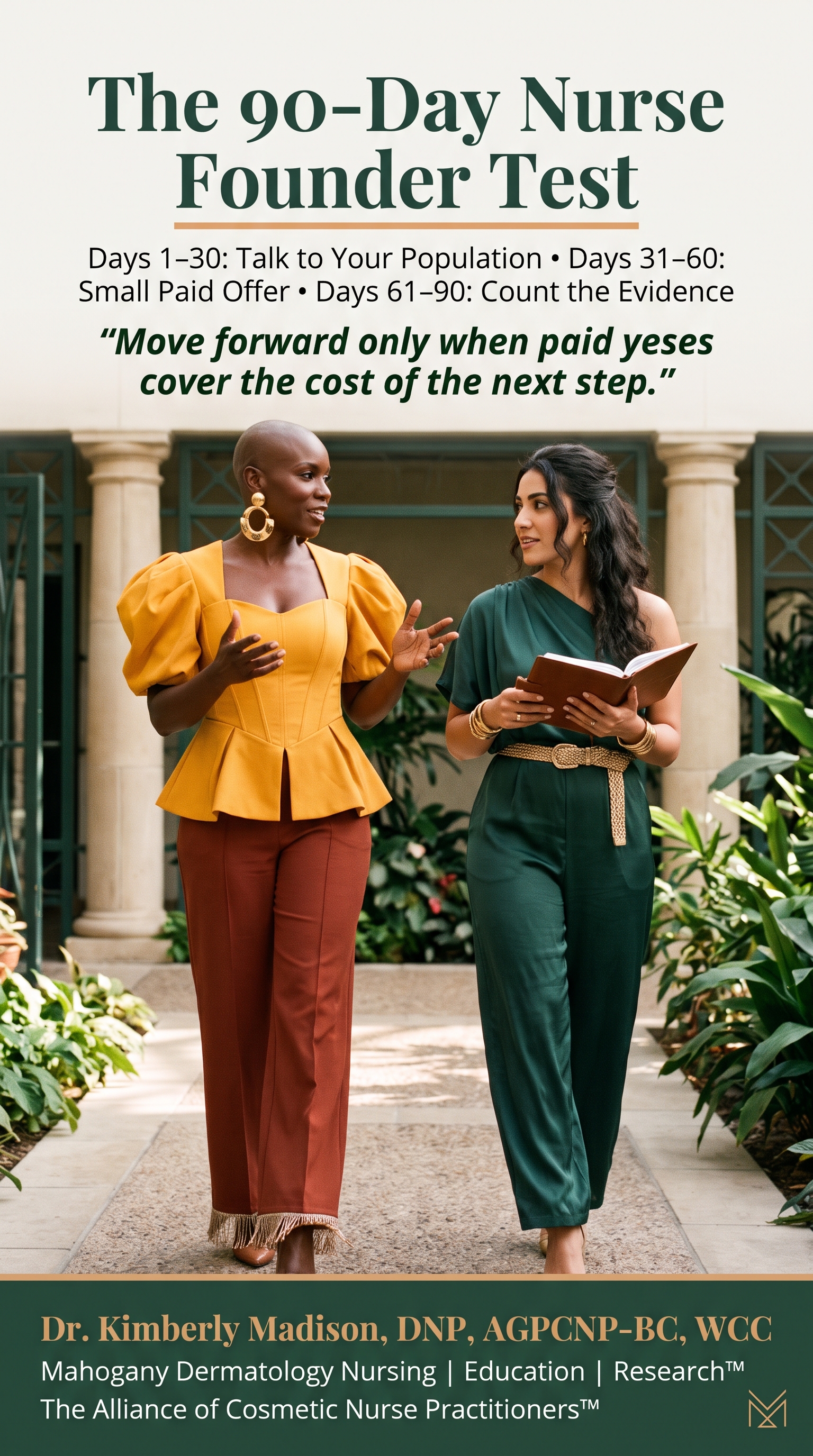
Here is a 90-day test for any idea in the lists above, adapted for nurse founders. First, choose one priority: get ready to sell, build the skill of selling, make the offer easier to say yes to, or build proof that the offer works. Then write five lines: the offer and its price, the target customer, why that customer would buy, the proof we have or need, and one sales goal for the 90 days. Next, divide the 90 days into days 1 to 30, 31 to 60, and 61 to 90, and for each stretch write what we will do, an effort target, and the result we will track. Our suggestion is to spend the first stretch talking with the population we picked (numbers 1 and 4), the second making a small paid offer such as a workshop, a screening day, or a pre-order, and the third counting the evidence. Each week, set targets for new prospects contacted, follow-ups, and conversations or offers, pick one selling skill to practice, and choose a day to review the results. Every conversation should end with a specific next step, such as a set day and time, instead of "send me an email." The decision rule is our addition: move forward only when the paid yeses cover the cost of the next step.
One Center can give every one of these paths a starting point
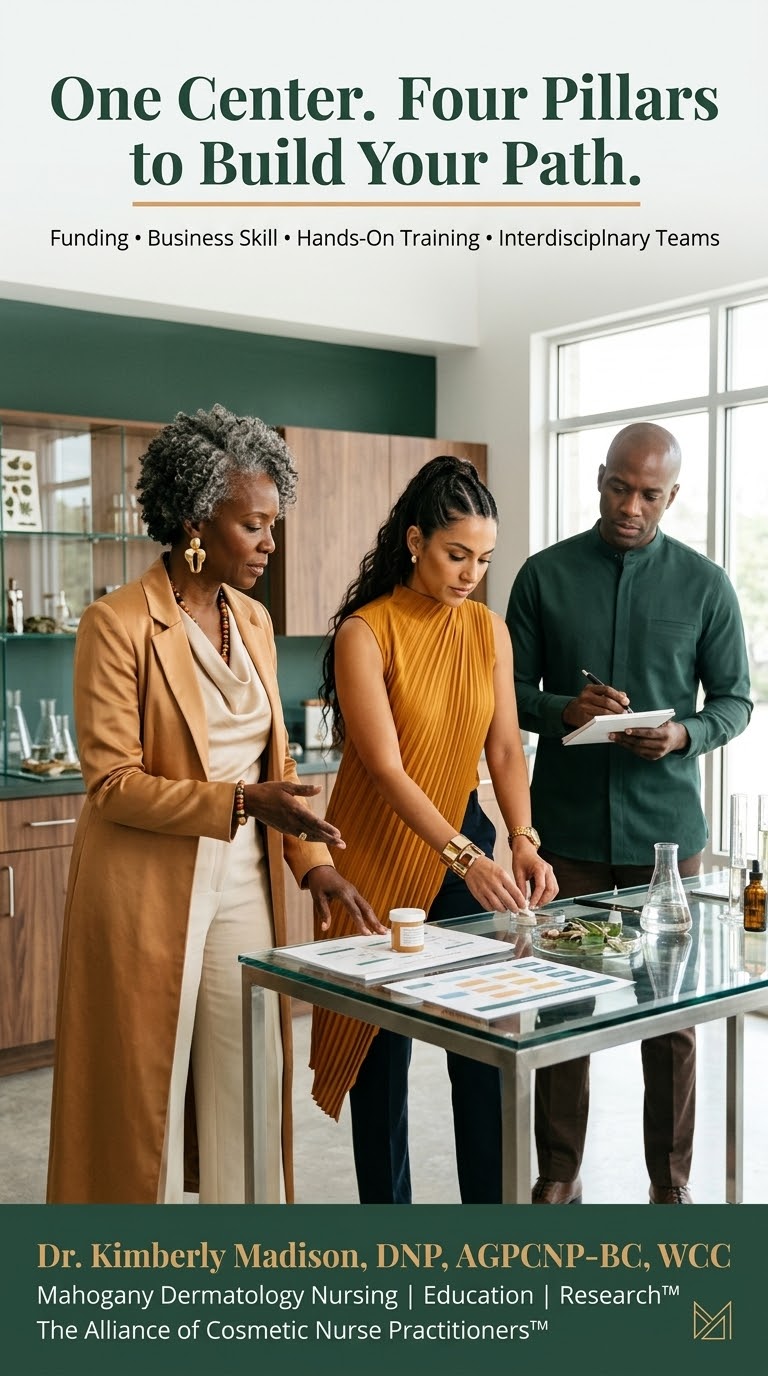
Every path above needs the same four things: funding, business skill, hands-on training, and the right professionals at the table. The Center we are building at Mahogany Dermatology Nursing | Education | Research™ is designed to bring them together. The Center combines access to funding, starting with grants and widening to government contracts and other sources, with business support from formation through operations and scaling, clinical hands-on training, and problem solving alongside engineers, scientists, illustrators, lawyers, and other professionals. When founders get that support, their practices stay open, and the patients we serve get the care they need when they need it.
Join the Email List
The Alliance of Cosmetic Nurse Practitioners™ is hosting our first virtual online summit MLK weekend, January 15-17, 2027, so we all have the tools and community to bring an idea to life. Registration is now open!! Don't miss the Black Friday Sale!
About the Author
Dr. Kimberly Madison, DNP, AGPCNP-BC, WCC is a Board-Certified, Doctorally-prepared Nurse Practitioner, educator, researcher, and author dedicated to advancing dermatology nursing education with an emphasis on skin of color, business acumen, and digital literacy. She is the founder of Mahogany Dermatology Nursing | Education | Research™ and the Alliance of Cosmetic Nurse Practitioners™, the first dermatology nursing organization in the country built at the intersection of clinical excellence, skin of color care, and financial literacy for nurses. A selected participant in the Harvard Business School Foundry Mindset Bootcamp (2026), Dr. Madison continues to sharpen the entrepreneurial infrastructure behind her mission. Through peer-reviewed research, published books, and a growing community of nurse entrepreneurs, Dr. Madison is building the infrastructure that makes this profession sustainable for the people who choose it.