You Cannot Sit at That Table Yet, And Here Is What Is Missing
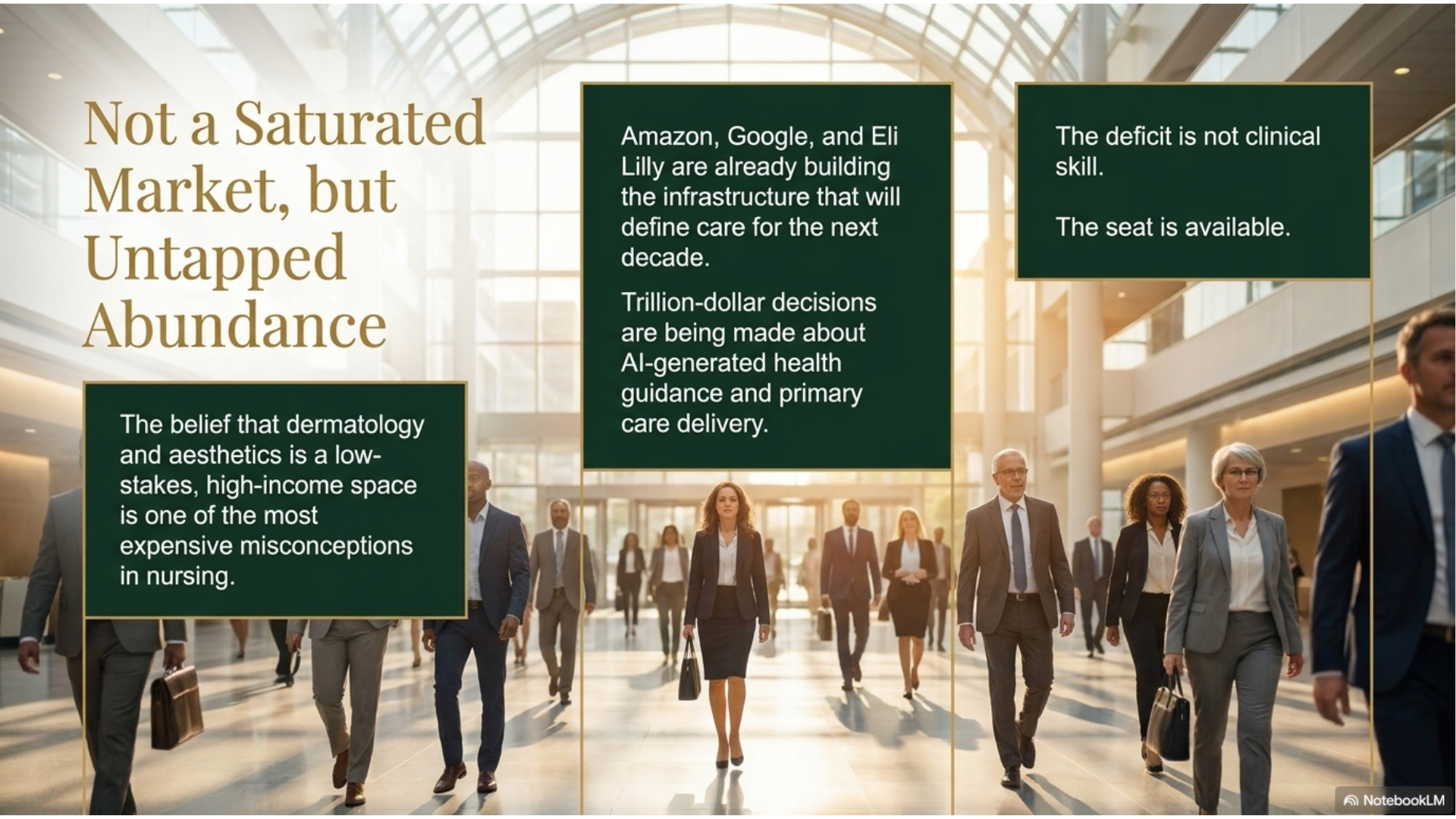
In this article, I want to pick up where "Dear Amazon" left off. That piece made the case that Amazon, Google, and Eli Lilly are already building the infrastructure that will define dermatology care for the next decade, and that nurse practitioners belong in the room where those decisions get made. This article asks the harder question. If the seat is available, are we ready to sit in it. The deficit is not clinical skill. It lives in identity, in financial literacy, in negotiation, and in the residue that toxic workplaces leave behind long after we've left them. Closing that deficit is what turns clinical authority into a real competitive advantage, and what's waiting on the other side of it is an opportunity most NPs are waiting for, but don't know where to start. I'm naming it here, piece by piece, because knowing this terrain is its own nursing superpower.
The Identity Shift That Has to Happen Before the Table Is Set
There's a phrase we use to introduce ourselves in rooms that matter, and it undersells everything we've built to get there: "I'm just a nurse." Not "doctoral-prepared clinician." Not "advanced practice provider with independent prescriptive authority." Not "the person who holds together the clinical infrastructure of every major health system in this country." Just a nurse. The qualifier lands before the credential, before the title, before the name.
Minimizing your own credential in a room where trillion-dollar decisions are being made about AI-generated health guidance, pharmaceutical trial design, and primary care delivery is asking the room to underestimate you, and the room will oblige. What reads as humility in clinical practice becomes a liability in a boardroom.
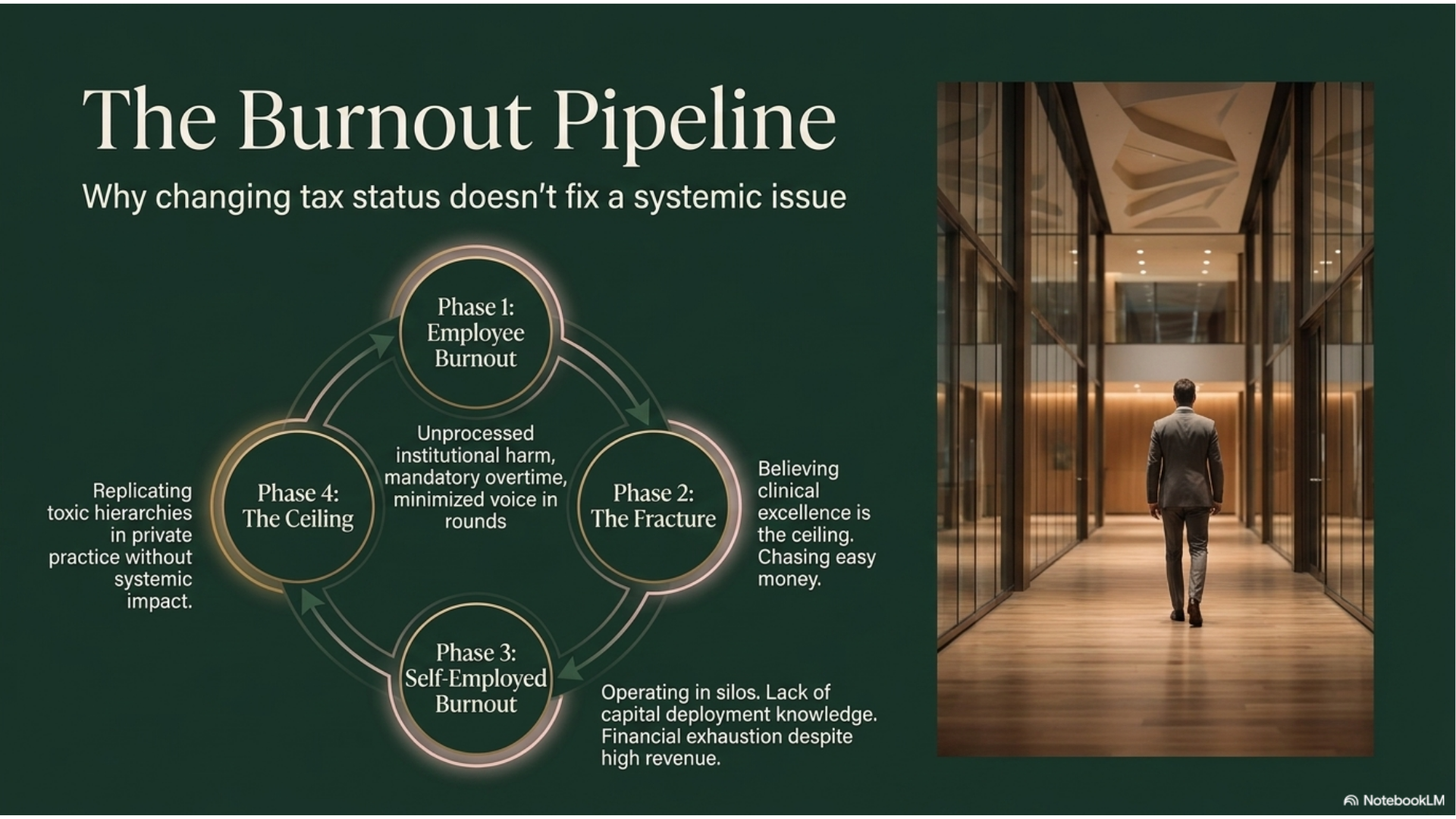
Many of us were trained inside a hierarchy that treated clinical excellence as the ceiling of ambition, one that kept nursing positioned beneath medicine for most of a century and taught us to read that positioning as natural rather than constructed. We've been talked over by people with fewer credentials and more confidence for long enough that some of us started mistaking the experience of being diminished for evidence that we deserved it, and the companies building the future of healthcare need us walking in already knowing that isn't true.
Financial Literacy Is a Clinical Competency
There's a reason so many of us generating six and seven figures in revenue still don't know what to do with the capital we've built. Financial literacy is a curriculum deficit our field has left standing for decades, absent from the ADN program, the BSN, the MSN, and even most DNP and PhD programs that claim to prepare us for systems-level leadership. No module on capital deployment. No case study on business valuation. Nursing education assumed the economic infrastructure of healthcare was someone else's job.
The result is a profession full of high earners who think like employees. Those attracted to dermatology and aesthetics aren't immune. A number enter the specialty chasing what looks like fast, low-stress income without doing the clinical due diligence first. Dermatology is one of the most intellectually complex specialties in medicine, with 3,000 to 4,000 distinct diagnoses and a physician pathway that runs four years of residency past medical school. The skin isn't the easiest organ system to learn. It's one of the hardest and most complicated because multiple diseases can have the same presentation.
Walking into Amazon's health division to negotiate a strategic advisory role, or Eli Lilly's equity team to inform clinical trial design, means knowing your worth before you name your number. That means understanding the Cashflow Quadrant, and knowing the difference between a consulting agreement and a board seat. That means reading a term sheet and recognizing when a room is offering access without authority.
Negotiation Is Our Nursing Superpower
We were trained to execute, to accommodate, to advocate for others, and to see negotiation as something every industry does but our own. That training doesn't disappear the moment we walk into a boardroom. It has to be actively unlearned and replaced with a framework.
Skilled negotiation is architecture: a structure where both parties can say yes to something and have to say no to something. It requires knowing how to quantify our clinical expertise in the language boards and investment committees actually speak, outcomes and market intelligence and financial upside, instead of leading with personal narrative. The ask requires knowing what the ask is worth, and naming a number without apologizing for it.
Turning Institutional Weight Into Boardroom Presence
Most of us carry an unprocessed archive from environments that called mandatory overtime "commitment," second-guessed our clinical judgment without clinical training, or promoted credential over outcome. That history doesn't stay in the building when we leave it. It shows up in the boardroom as a voice trained to go small, gratitude attached to conditions that didn't warrant it, and expertise framed as opinion instead of authority.
We trained relentlessly, passed every exam, and built practices and businesses from nothing, so the work now is rebuilding the mirror, not the resume. We heal from it by being in rooms where our expertise is treated as the asset it is, by receiving mentorship from people invested in our success, by building financial infrastructure that makes our presence in any room a choice rather than a necessity. Financial wholeness and professional identity aren't separate projects. They're the same project.
What the Dermatology-and-Aesthetics Complexity Actually Demands
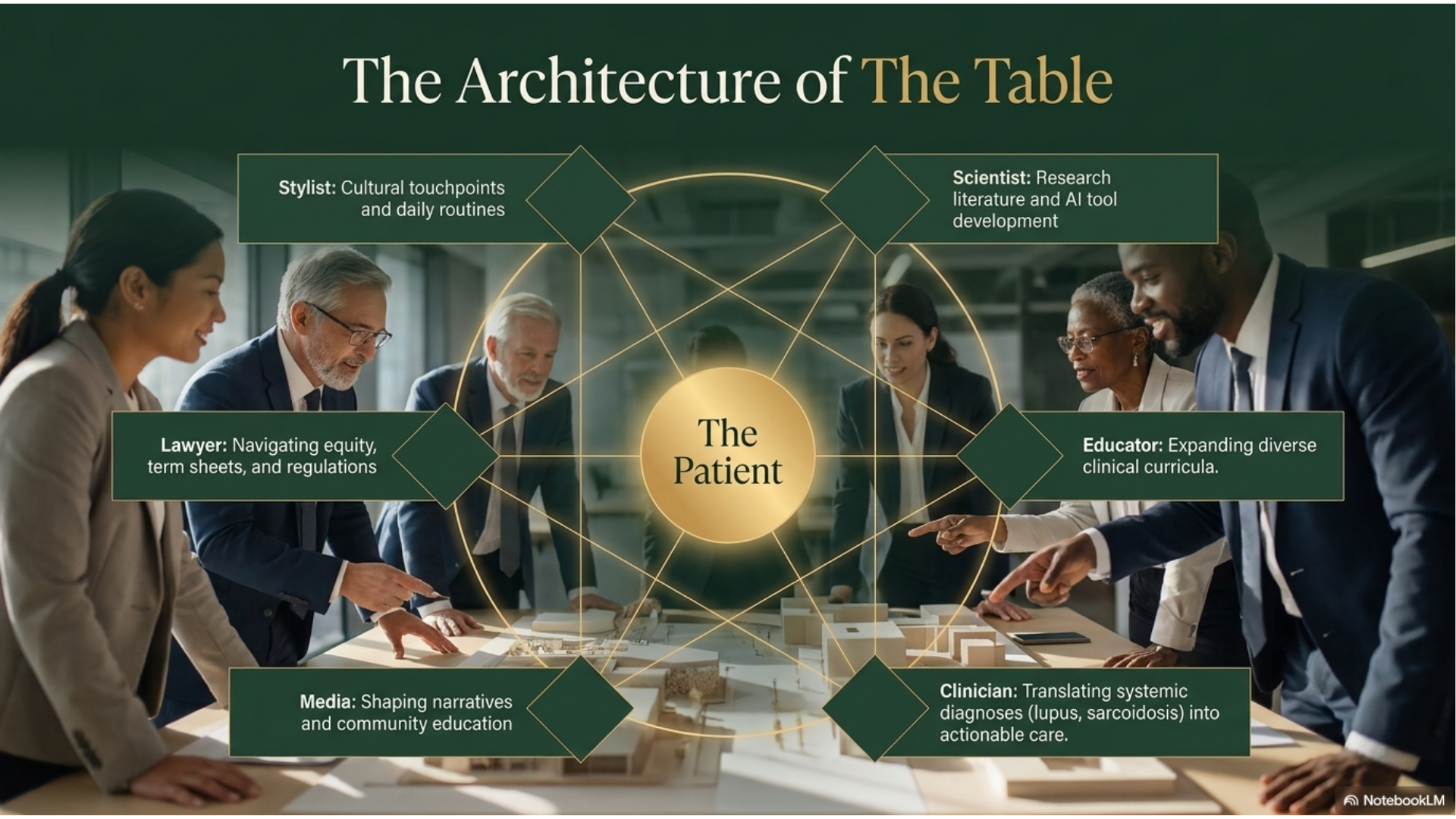
The belief that dermatology is a low-stakes, high-income specialty with minimal complexity is one of the most expensive misconceptions in nursing. It attracts providers who skip the clinical due diligence. It produces adverse events and missed diagnoses in patients who came in for cosmetic services. Dermatology carries one of the highest number of distinct diagnoses in medicine, and the skin is a diagnostic interface for every major organ system: lupus, sarcoidosis, Addison's disease, thyroid dysfunction, and dozens of autoimmune conditions present on it first.
Aesthetics carries the same clinical weight the industry has spent years minimizing. A medspa without a clinical director present, or a provider administering neurotoxin or filler without adequate vascular anatomy training, turns cosmetic risk into medical risk: blindness from filler embolism, necrosis from vascular occlusion, systemic infection from contaminated product.
Layered on top of this is the lack of diversity in dermatology education, training, research, and marketing. Conditions that present differently on diverse skin types are routinely misread when the training was built from a single skin tone. Amazon's virtual dermatology platform, Google's AI skin condition guidance, and Eli Lilly's community education programs are all operating in a field the people designing them don't fully understand. They need us at the table who do. Not in the comments section or conferences talking to each other about patients and content creators not being board-certified.
What Being Table-Ready Actually Looks Like
Clinical depth beyond the credential. Graduate education is the floor, not the ceiling. Being table-ready means studying dermatology as a complete medical specialty, not a weekend course or a handful of injectable techniques. Lupus shows up on the face before a rheumatologist ever sees the patient. Sarcoidosis shows up on the skin. Diabetes, peripheral vascular disease, and cancer all leave visible marks that a trained eye catches and an untrained eye writes off as dry skin or a rash. That's the difference between catching a systemic disease early and sending a patient home with a steroid cream. This is the standard behind Nursing Aesthetics: An Introductory Guide for Nurse Practitioners and Entrepreneurs and the Fibroid-Keloid-CCCA Research Initiative.
Financial literacy as a non-negotiable competency. These companies think in a language most nursing programs never teach: return on investment, market penetration, equity, valuation. Knowing the Cashflow Quadrant means knowing whether we're being offered a job with a fancy title or real ownership. Reading a term sheet means catching the clause that gives away our intellectual property before we ever sign it. Speak that language, and we sit at the table as a strategic voice. Don't, and we get treated as a resource to be consulted and dismissed.
Negotiation as a practiced skill. Asking for what we're worth. Structuring a pitch that leads with the outcome we deliver and the market data behind it. Knowing when to hold a number instead of softening it into a request. All of this is learnable the same way clinical skill is learnable, through repetition and feedback and practice, a craft rather than a personality trait some of us happen to have.
Identity built on what's already been proven. Ten years of being talked over in morning rounds doesn't undo itself the moment we walk into a boardroom. That confidence gets rebuilt the same way clinical confidence gets rebuilt, by standing on proof rather than waiting to feel ready. The nearly 3 decades of consistent public trust, research supporting our outcomes, credentials for every speciality (more being created to meet evolving needs), the published work, the community that already knows our name, that's the infrastructure that lets our presence in any room speak before we have to.
A bigger definition of what helping people means. Every one of us entered this profession to help people. Helping at the scale these companies operate at looks different from helping one patient in one exam room. It looks like sitting on the panel that shapes how an AI tool answers a skin condition question for a billion people a day. It looks like being the voice in the room who catches that a clinical trial design will miss half the patients it's meant to help before the trial ever launches. That reach starts with believing we belong in the room where those decisions get made.
The career we worked this hard for is supposed to work for us too. And that starts with naming all of our credentials, so we are no longer invisible to the people we serve or the generations to follow.
Amazon is already treating patients' skin conditions through a virtual clinic. The financial infrastructure that gets us into that room, and keeps our practices standing past year three, is exactly what Mahogany Dermatology Nursing | Education | Research was built to provide. Visit the Mahogany Dermatology Nursing Bookstore for the quarterly financial literacy e-books and start claiming your seat.
"And both of them require you to stop calling yourself just a nurse."
About the Author
Dr. Kimberly Madison, DNP, AGPCNP-BC, WCC is a Board-Certified, Doctorally-prepared Nurse Practitioner, educator, researcher, and author dedicated to advancing dermatology nursing education with an emphasis on skin of color, business acumen, and digital fluency. She is the founder of Mahogany Dermatology Nursing | Education | Research™ and the Alliance of Cosmetic Nurse Practitioners™, the first dermatology nursing organization in the country built at the intersection of clinical excellence, skin of color care, and financial literacy for nurses. A 2026 Harvard Business School Foundry Tech-Founder, Dr. Madison continues to sharpen the entrepreneurial infrastructure behind her mission. Through peer-reviewed research, published books, and a growing community of nurse entrepreneurs, Dr. Madison is building the infrastructure that makes this profession sustainable for the people who choose it.
.svg)

.svg)
.svg)